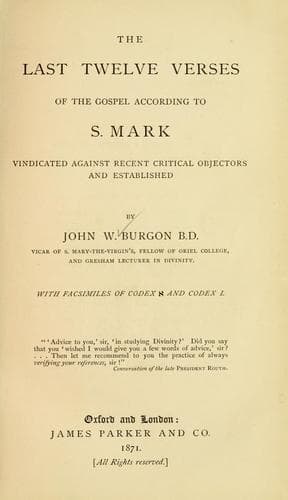
The Last Twelve Verses of the Gospel According to S. MarkBurgon, John William
Religion
The Last Twelve Verses of the Gospel According to S. Mark
Burgon, John William
Bible. Mark XVI, 9-20 -- Criticism, Textual
“In certain copies of Mark’s Gospel, next comes,—‘Now when [JESUS] was
risen early the first day of the week, He appeared to Mary Magdalene;’—a
statement which seems inconsistent with Matthew’s narrative. This might be
met by asserting, that the conclusion of Mark’s Gospel, though found in
certain copies, is spurious, However, that we may not seem to betake
ourselves to an off-hand answer, we propose to read the place thus:—‘Now
when [JESUS] was risen:’ then, after a comma, to go on,—‘early the first
day of the week He appeared to Mary Magdalene.’ In this way we refer
[Mark’s] ‘Now when [JESUS] was risen’ to Matthew’s ‘in the end of the
sabbath,’ (for _then_ we believe Him to have _risen_;) and all that comes
after, expressive as it is of a different notion, we connect with what
follows. Mark relates that He who ‘_arose_ (according to Matthew) _in the
end of the Sabbath_,’ _was seen_ by Mary Magdalene ‘_early_.’ This is in
fact what John also declares; for he too has recorded that ‘early,’ ‘the
first day of the week,’ [JESUS] appeared to the Magdalene. In a word, two
distinct seasons are set before us by these words: first, the season of
the Resurrection,—which was ‘in the end of the Sabbath;’ secondly, the
season of our SAVIOUR’S Appearing,—which was ‘early.’ ”(112)
No one, I presume, can read this passage and yet hesitate to admit that he
is here listening to Eusebius “ad Marinum” over again. But if any one
really retains a particle of doubt on the subject, he is requested to cast
his eye to the foot of the present page; and even an unlearned reader,
surveying the originals with attention, may easily convince himself that
_Victor is here nothing else but a copyist_.(113) That the work in which
Eusebius reconciles “seeming discrepancies in the Evangelical narratives,”
was actually lying open before Victor while he wrote, is ascertained
beyond dispute. He is observed in his next ensuing Comment to quote from
it, and to mention Eusebius as its author. At the end of the present note
he has a significant allusion to Eusebius:—“I know very well,” he says,
“what has been suggested _by those who are at the pains to remove the
apparent inconsistencies in this place_.”(114) But when writing on S. Mark
xvi. 9-20, he does more. After abridging, (as his manner is,) what
Eusebius explains with such tedious emphasis, (giving the substance of
five columns in about three times as many lines,) he adopts the exact
expressions of Eusebius,—follows him in his very mistakes,—and finally
transcribes his words. The reader is therefore requested to bear in mind
that what he has been listening to is _not the testimony of Victor at
all_: but _the testimony of Eusebius_. This is but one more echo therefore
of a passage of which we are all beginning by this time to be weary; so
exceedingly rash are the statements with which it is introduced, so
utterly preposterous the proposed method of remedying a difficulty which
proves after all to be purely imaginary.
Public-domain text, read in full here on John Shaqi.
Reviews
Reviews
No reviews yet
Be the first to share your thoughts on this work.
Join the Discussion
Join the discussion
Sign in to leave a comment or review.
Sign InorCreate an account