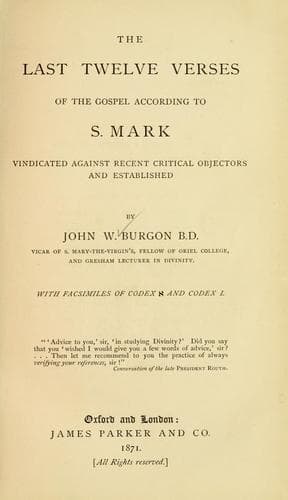
The Last Twelve Verses of the Gospel According to S. MarkBurgon, John William
Religion
The Last Twelve Verses of the Gospel According to S. Mark
Burgon, John William
Bible. Mark XVI, 9-20 -- Criticism, Textual
Now, his Commentary on S. Mark’s Gospel,—as all must see who will be at
the pains to examine it,—is to a great extent a compilation. The same
thing may be said, no doubt, to some extent, of almost every ancient
Commentary in existence. But I mean, concerning this particular work, that
it proves to have been the author’s plan not so much to give the general
results of his acquaintance with the writings of Origen, Apollinarius,
Theodorus of Mopsuestia, Eusebius, and Chrysostom; as, with or without
acknowledgment, to transcribe largely (but with great license) from one or
other of these writers. Thus, the whole of his note on S. Mark xv. 38, 39,
is taken, without any hint that it is not original, (much of it, _word for
word_,) from Chrysostom’s 88th Homily on S. Matthew’s Gospel.(108) The
same is to be said of the first twelve lines of his note on S. Mark xvi.
9. On the other hand, the latter half of the note last mentioned professes
to give the substance of what _Eusebius_ had written on the same subject.
It is in fact an extract from those very “Quaestiones ad Marinum”
concerning which so much has been offered already. All this, though it
does not sensibly detract from the interest or the value of Victor’s work,
must be admitted entirely to change the character of his supposed
evidence. He comes before us rather in the light of a Compiler than of an
Author: his work is rather a “Catena” than a Commentary: and as such in
fact it is generally described. Quite plain is it, at all events, that the
sentiments contained in the sections last referred to, are _not Victor’s
at all_. For one half of them, no one but Chrysostom is responsible: for
the other half, no one but Eusebius.
But it is Victor’s familiar use of the writings of Eusebius,—especially of
those Resolutions of hard Questions “concerning the seeming
Inconsistencies in the Evangelical accounts of the Resurrection,” which
Eusebius addressed to Marinus,—on which the reader’s attention is now to
be concentrated. Victor cites that work of Eusebius _by name_ in the very
_first_ page of his Commentary. That his _last_ page also contains a
quotation from it, (also _by name_), has been already pointed out.(109)
Attention is now invited to what is found concerning S. Mark xvi. 9-20 in
the _last page but one_ (p. 444) of Victor’s work. It shall be given in
English; because I will convince unlearned as well as learned readers.
Victor, (after quoting four lines from the 89th Homily of
Chrysostom(110)), reconciles (exactly as Eusebius is observed to do(111))
the notes of time contained severally in S. Matth. xxviii. 1, S. Mark xvi.
2, S. Luke xxiv. 1, and S. John xx. 1. After which, he proceeds as
follows:—
Public-domain text, read in full here on John Shaqi.
Reviews
Reviews
No reviews yet
Be the first to share your thoughts on this work.
Join the Discussion
Join the discussion
Sign in to leave a comment or review.
Sign InorCreate an account