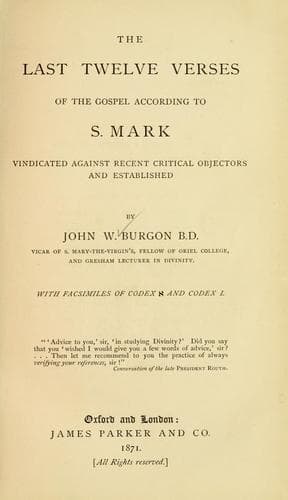
The Last Twelve Verses of the Gospel According to S. MarkBurgon, John William
Religion
The Last Twelve Verses of the Gospel According to S. Mark
Burgon, John William
Bible. Mark XVI, 9-20 -- Criticism, Textual
III. As for JEROME, since that illustrious Father comes before us in this
place as a _translator_ of Eusebius only, he is no more responsible for
what Eusebius says concerning S. Mark xvi. 9-20, than Hobbes of Malmesbury
is responsible for anything that Thucydides has related concerning the
Peloponnesian war. Individually, however, it is certain that Jerome was
convinced of the genuineness of S. Mark xvi. 9-20: for in two different
places of his writings he not only quotes the 9th and 14th verses, but he
exhibits all the twelve in the Vulgate.
IV. Lastly, VICTOR OF ANTIOCH, who wrote in an age when Eusebius was held
to be an infallible oracle on points of Biblical Criticism,—having
dutifully rehearsed, (like the rest,) the feeble expedient of that
illustrious Father for harmonizing S. Mark xvi. 9 with the narrative of S.
Matthew,—is observed to cite the statements of Eusebius concerning _the
last Twelve Verses_ of S. Mark, only in order to refute them. Not that he
opposes opinion to opinion,—(for the opinions of Eusebius and of Victor of
Antioch on this behalf were probably identical;) but statement he meets
with counter-statement,—fact he confronts with fact. Scarcely can anything
be imagined more emphatic than his testimony, or more conclusive.
For the reader is requested to observe that here is an Ecclesiastic,
writing in the first half of the vth century, who _expressly witnesses to
the genuineness_ of the Verses in dispute. He had made reference, he says,
and ascertained their existence in very many MSS. (ὡς ἐν πλείστοις). He
had derived his text from “accurate” ones: (ἐξ ἀκριβῶν ἀντιγράφων.) More
than that: he leads his reader to infer that he had personally resorted to
the famous Palestinian Copy, the text of which was held to exhibit the
inspired verity, and had satisfied himself that the concluding section of
S. Mark’s Gospel _was there_. He had, therefore, been either to Jerusalem,
or else to Cæsarea; had inquired for those venerable records which had
once belonged to Origen and Pamphilus;(119) and had inspected them.
Testimony more express, more weighty,—I was going to say, more
decisive,—can scarcely be imagined. It may with truth be said to close the
present discussion.
With this, in fact, Victor lays down his pen. So also may I. I submit that
nothing whatever which has hitherto come before us lends the slightest
countenance to the modern dream that S. Mark’s Gospel, as it left the
hands of its inspired Author, ended abruptly at ver. 8. Neither Eusebius
nor Jerome; neither Severus of Antioch nor Hesychius of Jerusalem;
certainly not Victor of Antioch; least of all Gregory of Nyssa,—yield a
particle of support to that monstrous fancy. The notion is an invention, a
pure imagination of the Critics ever since the days of Griesbach.
It remains to be seen whether the MSS. will prove somewhat less
unaccommodating.
VII. For it can be of no possible avail, at this stage of the discussion,
to appeal to
EUTHYMIUS ZIGABENUS,
Public-domain text, read in full here on John Shaqi.
Reviews
Reviews
No reviews yet
Be the first to share your thoughts on this work.
Elsewhere in the archive
Join the Discussion
Join the discussion
Sign in to leave a comment or review.
Sign InorCreate an account