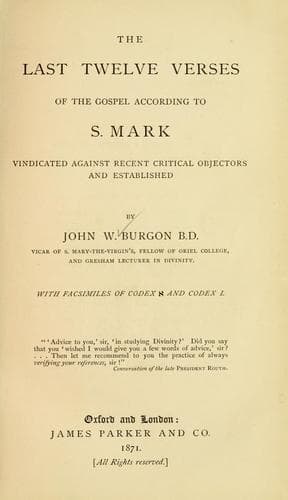
The Last Twelve Verses of the Gospel According to S. MarkBurgon, John William
Religion
The Last Twelve Verses of the Gospel According to S. Mark
Burgon, John William
Bible. Mark XVI, 9-20 -- Criticism, Textual
the Author of an interesting Commentary, or rather Compilation on the
Gospels, assigned to A.D. 1116. Euthymius lived, in fact, full five
hundred years too late for his testimony to be of the slightest
importance. Such as it is, however, it is not unfavourable. He says,—“Some
of the Commentators state that here,” (viz. at ver. 8,) “the Gospel
according to Mark finishes; and that what follows is a spurious addition.”
(Which clearly is his version of the statements of one or more of the four
Fathers whose testimony has already occupied so large a share of our
attention.) “This portion we must also interpret, however,” (Euthymius
proceeds,) “since there is nothing in it prejudicial to the
truth.”(120)—But it is idle to linger over such a writer. One might almost
as well quote “Poli _Synopsis_” and then proceed to discuss it. The cause
must indeed be desperate which seeks support from a quarter like this.
What possible sanction can an Ecclesiastic of the xiith century be
supposed to yield to the hypothesis that S. Mark’s Gospel, as it left the
hands of its inspired Author, was an unfinished work?
It remains to ascertain what is the evidence of the MSS. on this subject.
And the MSS. require to be the more attentively studied, because it is to
_them_ that our opponents are accustomed most confidently to appeal. On
them in fact they rely. The nature and the value of the most ancient
Manuscript testimony available, shall be scrupulously investigated in the
next two Chapters.
CHAPTER VI.
MANUSCRIPT TESTIMONY SHEWN TO BE OVERWHELMINGLY IN FAVOUR OF THESE
VERSES.—PART I.
S. Mark xvi. 9-20, contained in every MS. in the world except
two.—Irrational Claim to Infallibility set up on behalf of Cod. B
(p. 73) and Cod. א (p. 75).—These two Codices shewn to be full of
gross Omissions (p. 78),—Interpolations (p. 80),—Corruptions of
the Text (p. 81),—and Perversions of the Truth (p. 83).—The
testimony of Cod. B to S. Mark xvi. 9-20, shewn to be favorable,
notwithstanding (p. 86).
The two oldest Copies of the Gospels in existence are the famous Codex in
the Vatican Library at Rome, known as “Codex B;” and the Codex which
Tischendorf brought from Mount Sinai in 1859, and which he designates by
the first letter of the Hebrew alphabet (א). These two manuscripts are
probably not of equal antiquity.(121) An interval of fifty years at least
seems to be required to account for the marked difference between them. If
the first belongs to the beginning, the second may be referred to the
middle or latter part of the ivth century. But the two Manuscripts agree
in this,—that _they are without the last twelve verses of S. Mark’s
Gospel_. In both, after ἐφοβοῦντο γάρ (ver. 8), comes the subscription: in
Cod. B,—ΚΑΤΑ ΜΑΡΚΟΝ; in Cod. א,—ΕΥΑΓΓΕΛΙΟΝ ΚΑΤΑ ΜΑΡΚΟΝ.
Public-domain text, read in full here on John Shaqi.
Reviews
Reviews
No reviews yet
Be the first to share your thoughts on this work.
Elsewhere in the archive
Join the Discussion
Join the discussion
Sign in to leave a comment or review.
Sign InorCreate an account