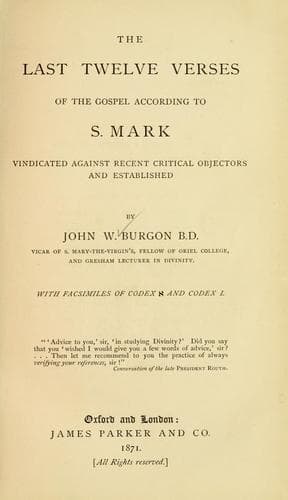
The Last Twelve Verses of the Gospel According to S. MarkBurgon, John William
Religion
The Last Twelve Verses of the Gospel According to S. Mark
Burgon, John William
Bible. Mark XVI, 9-20 -- Criticism, Textual
Let it not be supposed that we have any _more_ facts of this class to
produce. All has been stated. It is not that the evidence of Manuscripts
is one,—the evidence of Fathers and Versions another. The very reverse is
the case. Manuscripts, Fathers, and Versions alike, are _only not
unanimous_ in bearing consistent testimony. But the consentient witness of
the MSS. is even extraordinary. With the exception of the two uncial MSS.
which have just been named, there is _not one_ Codex in existence, uncial
or cursive,—(and we are acquainted with, at least, eighteen other
uncials,(122) and about six hundred cursive Copies of this Gospel,)—which
leaves out the last twelve verses of S. Mark.
The inference which an unscientific observer would draw from this fact, is
no doubt in this instance the correct one. He demands to be shewn the
Alexandrine (A) and the Parisian Codex (C),—neither of them probably
removed by much more than fifty years from the date of the Codex
Sinaiticus, and both unquestionably _derived from different
originals_;—and he ascertains that no countenance is lent by either of
those venerable monuments to the proposed omission of this part of the
sacred text. He discovers that the Codex Bezae (D), the only remaining
very ancient MS. authority,—notwithstanding that it is observed on most
occasions to exhibit an extraordinary sympathy with the Vatican (B),—here
sides with A and C against B and א. He inquires after all the other
uncials and all the cursive MSS. in existence, (some of them dating from
the xth century,) and requests to have it explained to him _why_ it is to
be supposed that all these many witnesses,—belonging to so many different
patriarchates, provinces, ages of the Church,—have entered into a grand
conspiracy to bear false witness on a point of this magnitude and
importance? But he obtains no intelligible answer to this question. How,
then, is an unprejudiced student to draw any inference but one from the
premisses? _That_ single peculiarity (he tells himself) of bringing the
second Gospel abruptly to a close at the 8th verse of the xvith chapter,
is absolutely fatal to the two Codices in question. It is useless to din
into his ears that those Codices are probably both of the ivth
century,—unless men are prepared to add the assurance that a Codex of the
ivth century is _of necessity_ a more trustworthy witness to the text of
the Gospels than a Codex of the vth. The omission of these twelve verses,
I repeat, in itself, destroys his confidence in Cod. B and Cod. א: for it
is obvious that a copy of the Gospels which has been so seriously
mutilated in one place may have been slightly tampered with in another. He
is willing to suspend his judgment, of course. The two oldest copies of
the Gospels in existence are entitled to great reverence _because_ of
their high antiquity. They must be allowed a most patient, most
unprejudiced, most respectful, nay, a most indulgent hearing. But when all
Public-domain text, read in full here on John Shaqi.
Reviews
Reviews
No reviews yet
Be the first to share your thoughts on this work.
Elsewhere in the archive
Join the Discussion
Join the discussion
Sign in to leave a comment or review.
Sign InorCreate an account