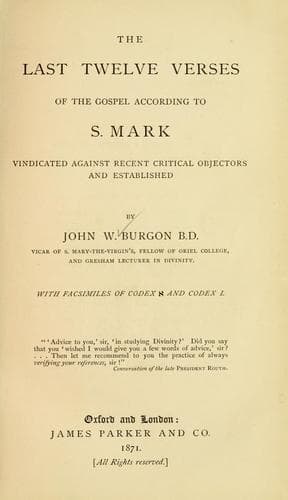
The Last Twelve Verses of the Gospel According to S. MarkBurgon, John William
Religion
The Last Twelve Verses of the Gospel According to S. Mark
Burgon, John William
Bible. Mark XVI, 9-20 -- Criticism, Textual
II. More recently, a claim to co-ordinate primacy has been set up on
behalf of the Codex Sinaiticus. Tischendorf is actually engaged in
remodelling his seventh Leipsic edition, chiefly in conformity with the
readings of his lately discovered MS.(129) And yet the Codex in question
abounds with “errors of the the eye and pen, to an extent not
unparalleled, but happily rather unusual in documents of first-rate
importance.” On many occasions, 10, 20, 30, 40 words are dropped through
very carelessness.(130) “Letters and words, even whole sentences, are
frequently written twice over, or begun and immediately cancelled: while
that gross blunder ... whereby a clause is omitted because it happens to
end in the same words as the clause preceding, occurs no less than 115
times in the New Testament. Tregelles has freely pronounced that ‘the
state of the text, as proceeding from the first scribe, may be regarded as
_very rough_.’ ”(131) But when “the first scribe” and his “very rough”
performance have been thus unceremoniously disposed of, one would like to
be informed what remains to command respect in Codex א? Is, then,
_manuscript authority_ to be confounded with _editorial
caprice_,—exercising itself upon the corrections of “at least ten
different revisers,” who, from the vith to the xiith century, have been
endeavouring to lick into shape a text which its original author left
“_very rough_?”
The co-ordinate primacy, (as I must needs call it,) which, within the last
few years, has been claimed for Codex B and Codex א, threatens to grow
into a species of tyranny,—from which I venture to predict there will come
in the end an unreasonable and unsalutary recoil. It behoves us,
therefore, to look closely into this matter, and to require a reason for
what is being done. The text of the sacred deposit is far too precious a
thing to be sacrificed to an irrational, or at least a superstitious
devotion to two MSS.,—simply because they may possibly be older by a
hundred years than any other which we possess. “Id verius quod prius,” is
an axiom which holds every bit as true in Textual Criticism as in Dogmatic
Truth. But on that principle, (as I have already shewn,) the last twelve
verses of S. Mark’s Gospel are fully established;(132) and by consequence,
the credit of Codd. B and א sustains a severe shock. Again, “Id verius
quod prius;” but it does not of course follow that a Codex of the ivth
century shall exhibit a more correct text of Scripture than one written in
the vth, or even than one written in the xth. For the proof of this
statement, (if it can be supposed to require proof,) it is enough to
appeal to Codex D. That venerable copy of the Gospels is of the vith
century. It is, in fact, one of our five great uncials. No older MS. of
the Greek Text is known to exist,—excepting always A, B, C and א. And yet
_no_ text is more thoroughly disfigured by corruptions and interpolations
than that of Codex D. In the Acts, (to use the language of its learned and
Public-domain text, read in full here on John Shaqi.
Reviews
Reviews
No reviews yet
Be the first to share your thoughts on this work.
Elsewhere in the archive
Join the Discussion
Join the discussion
Sign in to leave a comment or review.
Sign InorCreate an account