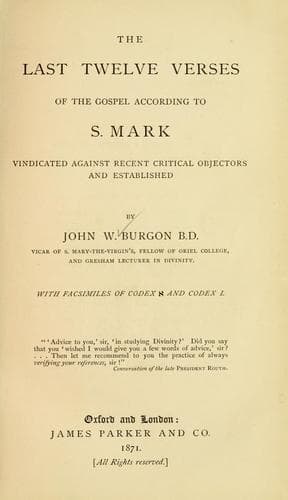
The Last Twelve Verses of the Gospel According to S. MarkBurgon, John William
Religion
The Last Twelve Verses of the Gospel According to S. Mark
Burgon, John William
Bible. Mark XVI, 9-20 -- Criticism, Textual
accurate Editor,) “it is hardly an exaggeration to assert that it
reproduces the _textus receptus_ much in the same way that one of the best
Chaldee Targums does the Hebrew of the Old Testament: so wide are the
variations in the diction, so constant and inveterate the practice of
expanding the narrative by means of interpolations which seldom recommend
themselves as genuine by even a semblance of internal probability.”(133)
Where, then, is the _à priori_ probability that two MSS. of the ivth
century shall have not only a superior claim to be heard, but almost an
exclusive right to dictate which readings are to be rejected, which
retained?
How ready the most recent editors of the New Testament have shewn
themselves to hammer the sacred text on the anvil of Codd. B and א,—not
unfrequently in defiance of the evidence of all other MSS., and sometimes
to the serious detriment of the deposit,—would admit of striking
illustration were this place for such details. Tischendorf’s English “_New
Testament_”—“with various readings from the three most celebrated
manuscripts of the Greek Text” translated at the foot of every page,—is a
recent attempt (1869) to popularize the doctrine that we have to look
exclusively to two or three of the oldest copies, if we would possess the
Word of GOD in its integrity. Dean Alford’s constant appeal in his
revision of the Authorized Version (1870) to “the oldest MSS.” (meaning
thereby generally Codd. א and B with one or two others(134)), is an abler
endeavour to familiarize the public mind with the same belief. I am bent
on shewing that there is nothing whatever in the character of either of
the Codices in question to warrant this servile deference.
(_a_) And first,—Ought it not sensibly to detract from our opinion of the
value of their evidence to discover that _it is easier to find two
consecutive verses in which the two MSS. differ, the one from the other,
than two consecutive verses in which they entirely agree_? Now this is a
plain matter of fact, of which any one who pleases may easily convince
himself. But the character of two witnesses who habitually contradict one
another has been accounted, in every age, precarious. On every such
occasion, only one of them can possibly be speaking the truth. Shall I be
thought unreasonable if I confess that these _perpetual_ inconsistencies
between Codd. B and א,—grave inconsistencies, and occasionally even gross
ones,—altogether destroy my confidence in either?
(_b_) On the other hand, discrepant as the testimony of these two MSS. is
throughout, they yet, strange to say, conspire every here and there in
exhibiting minute corruptions of such an unique and peculiar kind as to
betray a (probably not very remote) common corrupt original. These
coincidences in fact are so numerous and so extraordinary as to establish
a real connexion between those two codices; and that connexion is fatal to
any claim which might be set up on their behalf as wholly independent
witnesses.(135)
Public-domain text, read in full here on John Shaqi.
Reviews
Reviews
No reviews yet
Be the first to share your thoughts on this work.
Elsewhere in the archive
Join the Discussion
Join the discussion
Sign in to leave a comment or review.
Sign InorCreate an account