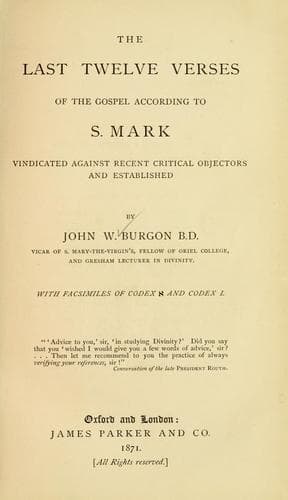
The Last Twelve Verses of the Gospel According to S. MarkBurgon, John William
Religion
The Last Twelve Verses of the Gospel According to S. Mark
Burgon, John William
Bible. Mark XVI, 9-20 -- Criticism, Textual
(2.) In Codd. 20 and 300 (Scholz proceeds) we read as follows:—“From here
to the end forms no part of the text in some of the copies. _In the
ancient copies, however, it all forms part of the text_.”(202) Scholz (who
was the first to adduce this important testimony to the genuineness of the
verses now under consideration) takes no notice of the singular
circumstance that the two MSS. he mentions have been _exactly_ assimilated
in ancient times to a common model; and that they correspond one with the
other so entirely(203) that the foregoing rubrical annotation appears _in
the wrong place_ in both of them, viz. _at the close of ver._ 15, where it
interrupts the text. This was, therefore, once a scholion written in the
margin of some very ancient Codex, which has lost its way in the process
of transcription; (for there can be no doubt that it was originally
written against ver. 8.) And let it be noted that its testimony is
express; and that it avouches for the fact that “_in the ancient copies_,”
S. Mark xvi. 9-20 “_formed part of the text_.”
(3.) Yet more important is the record contained in the same two MSS., (of
which also Scholz says nothing,) viz. that they exhibit a text which had
been “collated with the ancient and approved copies at Jerusalem.”(204)
What need to point out that so remarkable a statement, taken in
conjunction with the express voucher that “although some copies of the
Gospels are without the verses under discussion, yet that _in the ancient
copies_ all the verses are found,” is a _critical attestation to the
genuineness_ of S. Mark xvi. 9 to 20, far outweighing the bare statement
(next to be noticed) of the undeniable historical fact that, “_in some
copies_,” S. Mark _ends at ver._ 8,—but “in many _does not_”?
(4.) Scholz proceeds:—“In Cod. 22, after ἐφοβοῦντο γάρ + τελος is read the
following rubric:”—
ἔν τισι τῶν ἀντιγράφων ἕως ὧδε πληροῦται ὁ εὐαγγελιστής: ἐν πολλοῖς δὲ καὶ
ταῦτα φέρεται.(205)
And the whole of this statement is complacently copied by _all_ subsequent
Critics and Editors,—cross, and “τέλος,” and all,—as an additional ancient
attestation to the fact that “_The End_” (τέλος) _of S. Mark’s Gospel_ is
indeed at ch. xvi. 8. Strange,—incredible rather,—that among so many
learned persons, not one should have perceived that “τέλος” in this place
merely denotes that here _a well-known Ecclesiastical section comes to an
end_!... As far, therefore, as the present discussion is concerned, the
circumstance is purely irrelevant;(206) and, (as I propose to shew in
Chapter XI,) the less said about it by the opposite party, the better.
(5.) Scholz further states that in four, (he means three,) other Codices
very nearly the same colophon as the preceding recurs, with an important
additional clause. In Codd. 1, 199, 206, 209, (he says) is read,—
Public-domain text, read in full here on John Shaqi.
Reviews
Reviews
No reviews yet
Be the first to share your thoughts on this work.
Elsewhere in the archive
Join the Discussion
Join the discussion
Sign in to leave a comment or review.
Sign InorCreate an account