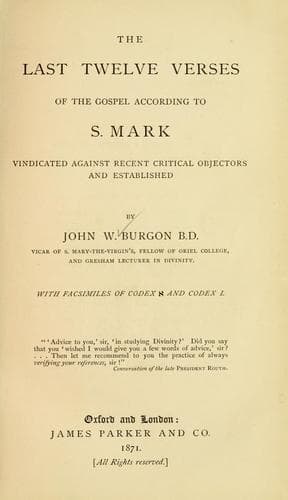
The Last Twelve Verses of the Gospel According to S. MarkBurgon, John William
Religion
The Last Twelve Verses of the Gospel According to S. Mark
Burgon, John William
Bible. Mark XVI, 9-20 -- Criticism, Textual
each of those several Gospels in turn, until the required number has been
reached,) will be found to contain the parallel record in the other three
Gospels.
All this is so purely elementary, that its very introduction in this place
calls for apology. The extraordinary method of the opposite party
constrains me however to establish thus clearly the true relation in which
the familiar labours of Eusebius stand to the unknown work of Ammonius.
For if that earlier production be lost indeed,(225)—if its precise
contents, if the very details of its construction, can at this distance of
time be only conjecturally ascertained,—what right has any one to appeal
to “_the Sections of Ammonius_,” as to a known document? Why above all do
Tischendorf, Tregelles, and the rest deliberately claim “Ammonius” for
their ally on an occasion like the present; seeing that they must needs be
perfectly well aware that they have no means whatever of knowing (except
from the precarious evidence of Catenæ) what Ammonius thought about any
single verse in any of the four Gospels? At every stage of this
discussion, I am constrained to ask myself,—Do then the recent Editors of
the Text of the New Testament really suppose that their statements will
_never_ be examined? their references _never_ verified? or is it thought
that they enjoy a monopoly of the learning (such as it is) which enables a
man to form an opinion in this department of sacred Science? For,
(1st.) _Where_ then and _what_ are those “Sections of Ammonius” to which
Tischendorf and Tregelles so confidently appeal? It is even notorious that
when they _say_ the “Sections of Ammonius,” what they _mean_ are the
“Sections of _Eusebius_.”—But, (2dly.) Where is the proof,—where is even
the probability,—that these two are identical? The Critics cannot require
to be reminded by me that we are absolutely without proof that so much as
_one_ of the Sections of Ammonius corresponded with _one_ of those of
Eusebius; and yet, (3dly.) Who sees not that unless the Sections of
Ammonius and those of Eusebius can be proved to have corresponded
throughout, the name of Ammonius has no business whatever to be introduced
into such a discussion as the present? They must at least be told that in
the entire absence of proof of any kind,—(and certainly nothing that
Eusebius says warrants any such inference,(226))—to reason from the one to
the other as if they were identical, is what no sincere inquirer after
Truth is permitted to do.
Public-domain text, read in full here on John Shaqi.
Reviews
Reviews
No reviews yet
Be the first to share your thoughts on this work.
Elsewhere in the archive
Join the Discussion
Join the discussion
Sign in to leave a comment or review.
Sign InorCreate an account