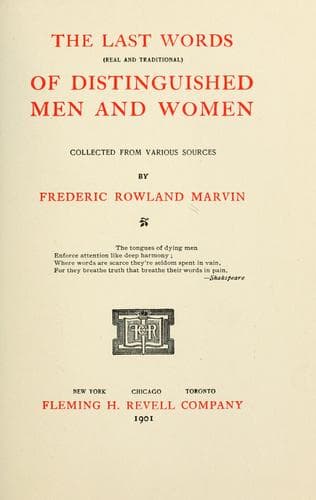
The Last Words (Real and Traditional) of Distinguished Men and WomenMarvin, Frederic Rowland
History
The Last Words (Real and Traditional) of Distinguished Men and Women
Marvin, Frederic Rowland
Last words
Then came the day of execution, July 19, 1692. At an early hour the
little village was bristling with activity. "The devil's angel on earth"
was to be punished with the death she deserved, and so the Puritan
maidens attired themselves in holiday dress to honor the event. The
procession to the gallows was a long one, scores of people from the
neighboring towns and villages taking part. The victim, manacled and
guarded by the sheriff and his deputy, headed the line, while close
behind followed troops of men and women who laughed, deeming it rare
sport to see the agonized faces of the terror-stricken family as they
watched the mother and wife grow pale, and tremble as she began the
ascent of the rocky cliff whose top was crowned with the instrument of
death. It is impossible in words to depict the scene of the execution in
the horrible colors in which tradition has painted it. With firm steps
and eyes upturned to heaven, the gray-haired woman took her place on the
drop. Silently the hangman tied the rope before the eager waiting
assembly; then a momentary hush passed over the crowd--the
executioner's duty was done. A moment later all that was left to tell
the story was the body of the aged woman swinging gently in the summer
wind.
Seldom has a woman met with a harder fate. Her body was thrown with the
previous victims into a hole in a crevice of the rocks, and hastily
covered with earth. Then the masses of spectators turned homeward,
leaving the bereaved family at the homestead uncared for and ignored by
their once firm friends.
It is a family tradition that in some way the remains of Mrs. Nourse
were recovered by her husband and sons and interred in the spot which is
now pointed out on the estate as her grave. Imagination only can recall
the details of the event, so sad and awful. In the darkness of night the
sons hasten to the new-made grave, throw off the slight covering of
earth, and by the feeble light of a lantern discover the remains. What
feelings of revenge and sorrow must have stirred their hearts as they
raised their mother's soulless frame tenderly in their arms, and carried
it along through woods and valleys, over highways and fields to the
homestead, where, on the following night, the three pronounced the only
burial service over the remains, as they lowered the body into a
newly-made grave in their own consecrated grounds, which down through
the generations has been reverently guarded.
A beautiful shaft of granite has been erected over her grave by her
descendants. The monument is of Rockport and Quincy granite, and is
eight and a half feet high. The base and apex are of Rockport granite,
and the die of Quincy granite, polished and lettered as follows:
REBECCA NOURSE.
YARMOUTH, ENGLAND.
1621.
SALEM, MASS.
1692.
Public-domain text, read in full here on John Shaqi.
Reviews
Reviews
No reviews yet
Be the first to share your thoughts on this work.
Elsewhere in the archive
Join the Discussion
Join the discussion
Sign in to leave a comment or review.
Sign InorCreate an account