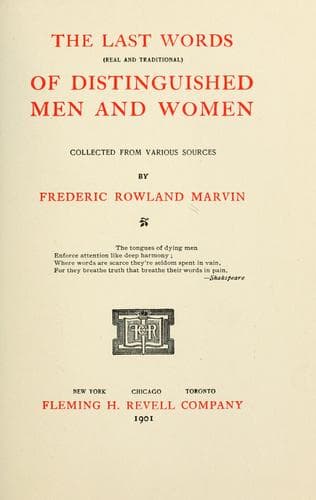
The Last Words (Real and Traditional) of Distinguished Men and WomenMarvin, Frederic Rowland
History
The Last Words (Real and Traditional) of Distinguished Men and Women
Marvin, Frederic Rowland
Last words
There is a dispute with regard to Paine's death. Some writers say he
recanted and became a Christian, while others affirm that he died as he
lived--an avowed Deist. In his last will and testament he says: "I have
lived an honest and useful life to mankind; my time has been spent in
doing good; and I die in perfect composure and resignation to the will
of my creator, God." On the other hand some authors say that he was
grossly intemperate and licentious, and that he discarded Christianity,
not so much from conviction as from a base desire to lead a bad life.
"In 1802, he (Paine) returned to America and resided a part of the time
on a farm at New Rochelle, presented to him by the State of New York for
his Revolutionary service. Paine became very intemperate, and fell low
in the social scale, not only on account of his beastly habits, but
because of his blasphemous tirade against Christianity."
_Lossing in "Our Countrymen."_
Of Paine's last hours Rev. O. B. Frothingham speaks as follows:
"The truth is, that Paine, though not rich, was in comfortable
circumstances. He had considerable property, which is specified in his
will. His sick bed was surrounded by friends who ministered to his
wants, witnessed the firmness and calmness of his last hours, and
attested the sincerity and sufficiency of his convictions. Not even the
impertinent intrusiveness of the clergy disturbed the entire serenity of
his death."
The commonly received opinion, and most likely the correct one, with
regard to Paine is this which we excerpt from _Appleton's Cyclopaedia of
Biography_:
"His attacks upon religion had exceedingly narrowed his circle of
acquaintance; and his habitual intemperance tended to the injury of his
health and the ultimate production of a complication of disorders, to
which he fell a victim in 1809. The Quakers refused to admit his remains
among their dead, and he was buried on his own farm. Cobbett boasted of
having disinterred him in 1817, and of having brought his body to
England; many, however, assert that Cobbett did not take that trouble,
but brought over from America the remains of a criminal who had been
executed."[39]
Public-domain text, read in full here on John Shaqi.
Reviews
Reviews
No reviews yet
Be the first to share your thoughts on this work.
Elsewhere in the archive
Join the Discussion
Join the discussion
Sign in to leave a comment or review.
Sign InorCreate an account