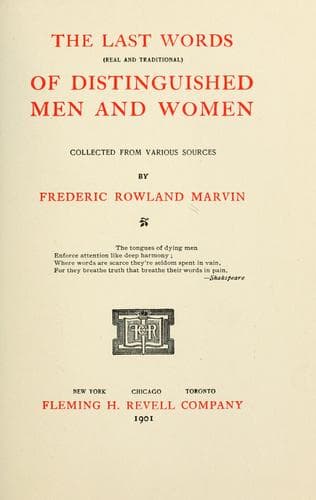
The Last Words (Real and Traditional) of Distinguished Men and WomenMarvin, Frederic Rowland
History
The Last Words (Real and Traditional) of Distinguished Men and Women
Marvin, Frederic Rowland
Last words
Palmer was a man of acute and affectionate feelings, which had been much
exercised by the course and events of his life. He had recently lost his
wife and a favorite son, labored in consequence under profound grief and
depression of mind which he strove to overcome, and had expressed a
conviction that these mental sufferings would very shortly bring him to
his grave. During some days he seemed, however, to bear up against his
misfortunes, and performed in some pieces, including _The Stranger_,
with much success. About a week afterward he appeared a second time in
that character, when he fell a victim to the poignancy of his feelings.
On the morning of the day he was much dejected, but exerted himself with
great effect in the first and second acts of the play. In the third act
he showed evident marks of depression; and in the fourth, when about to
reply to the question of Baron Steinfort relative to his children,
appeared unusually agitated. He endeavored to proceed, but his feelings
overcame him. The hand of death arrested his progress, and he fell on
his back, heaved a convulsive sigh and instantly expired without a
groan. Having been removed to the scene-room, and medical aid
immediately procured, his veins were opened, but yielded not a single
drop of blood, and every other means of resuscitation was tried without
effect. His death was by most persons ascribed to apoplexy; but Dr.
Mitchell and Dr. Corry gave it as their opinion that he certainly died
of a broken heart, in consequence of the family afflictions which he had
recently experienced.
_Annual Register._
PARK (Edwards Amasa, distinguished American theologian, author and
translator, professor in Andover Theological Seminary, and one of the
editors of the "Bibliotheca Sacra"), 1808-1899. "_These passages may be
found on the following pages._" His mind was wandering, and, like Dr.
Adam, head master at the High School in Edinburgh, he thought himself
once more in the class-room.
PARKER (Theodore, Unitarian preacher and writer), 1810-1869. "_It is all
one, Phillips and Clarke will come for my sake._" He meant that Wendell
Phillips and James Freeman Clarke would attend his funeral. He died at
Florence, where he had gone for his health. The character of Theodore
Parker was above reproach. His tone of morality was high. His motives
were elevated, and, apparently, sincere. His firm grasp of some of the
fundamental principles of natural religion, together with his unfailing
confidence in his own powers, gave a strength to his utterances of truth
and duty which often stirred and swayed the moral nature of his hearers.
But in all his writings we find no expression of a consciousness of
guilt and of need as a sinner, and no recognition of Christ as a
Saviour. Of Theodore Parker, Lowell speaks thus wittily, in his "Fables
for Critics:"
Public-domain text, read in full here on John Shaqi.
Reviews
Reviews
No reviews yet
Be the first to share your thoughts on this work.
Elsewhere in the archive
Join the Discussion
Join the discussion
Sign in to leave a comment or review.
Sign InorCreate an account