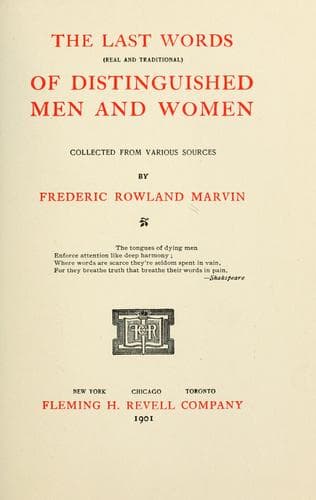
The Last Words (Real and Traditional) of Distinguished Men and WomenMarvin, Frederic Rowland
History
The Last Words (Real and Traditional) of Distinguished Men and Women
Marvin, Frederic Rowland
Last words
PERCEVAL (Spencer, distinguished statesman, assassinated on the 11th of
May, 1812, in the lobby of the House of Commons, by John Bellingham),
1762-1812. "_O my God!_"
PESTEL (Paul, Russian revolutionist, author of "Pestel's Hymn." He was a
brave man who loved liberty, and desired to establish it upon the ruins
of Russian absolutism), 1794-1826. "_Stupid country, where they do not
even know how to hang._" These words were spoken when the rope broke by
which he was to be hanged.
PETER (His original name was Simon; but when he became a disciple of
Christ he received the name Peter, which in Greek signifies a "rock." He
was sometimes called Cephas. He was one of the most distinguished of the
twelve apostles of our Lord, and is the author of two epistles included
in the canon of Scripture),--65. "_Remember the Lord Jesus Christ._"
These words which rest upon the authority of Eusebius, Peter is said to
have addressed to his wife on seeing her going to martyrdom. Some
suppose that he was himself at the time suspended upon the cross.[40]
[40] It is said that Peter was crucified with his head down, himself
so requesting, because he thought himself unworthy to be crucified
in the same manner as his Lord.
PETER I. (of Russia, "Peter the Great"), 1672-1725. "_I believe, Lord,
and confess; help my unbelief._"
PETER III. (Feodorovitch, of Russia, grandson of "Peter the Great." He
drew down upon himself, by his innovations, the enmity of the nobles and
clergy, and was in consequence dethroned and strangled by conspirators,
of whom his wife, the profligate, cruel and infamous Catherine II. was
an accomplice), 1728-1762. "_It was not enough to deprive me of the
Crown of Russia, but I must be put to death._"
PETERS (Hugh, distinguished clergyman and politician, pastor of the
First Congregational Church in Salem, Mass., succeeding Roger Williams,
"whose doctrines he disclaimed and whose adherents he excommunicated."
In 1637 he was appointed overseer of Harvard. In 1641 he returned to
England, where he joined the Parliamentary party, and became a chaplain
in the army. After the restoration of Charles II. Peters was committed
to the Tower, and indicted for high treason. He was executed in London,
Oct. 16, 1660), 1599-1660. "_Friend, you do not well to trample on a
dying man._"
When Hugh Peters was carried on a sledge to the scaffold, he was made to
sit within the rails, and see the execution of Mr. Cook. When the latter
was cut down to be quartered, Colonel Turner ordered the sheriff's men
to bring Mr. Peters near, that he might see it; and when soon after the
hangman rubbed his blood-stained hands together, he tauntingly asked,
"Come, how do you like this work, Mr. Peters?" He calmly replied,
"Friend, you do not well to trample on a dying man."
_The Percy Anecdotes._
Public-domain text, read in full here on John Shaqi.
Reviews
Reviews
No reviews yet
Be the first to share your thoughts on this work.
Elsewhere in the archive
Join the Discussion
Join the discussion
Sign in to leave a comment or review.
Sign InorCreate an account