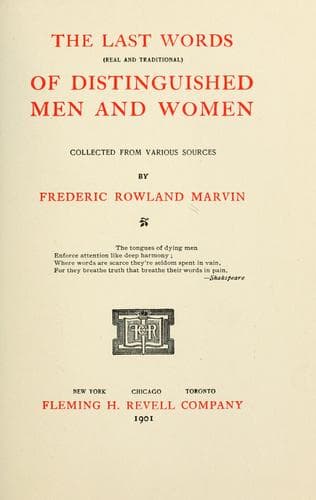
The Last Words (Real and Traditional) of Distinguished Men and WomenMarvin, Frederic Rowland
History
The Last Words (Real and Traditional) of Distinguished Men and Women
Marvin, Frederic Rowland
Last words
Away went Mr. Saunders, with a merry courage, toward the fire. He fell
to the ground and prayed; he rose up again and took the stake to which
he should be chained in his arms and kissed it, saying: "Welcome the
cross of Christ, welcome everlasting life." Being fastened to the stake
he fell full sweetly asleep in the Lord.
_Fox's "Book of Martyrs."_
SAVONAROLA (Girolamo, celebrated preacher and political, as well as
religious, reformer of Florence), 1452-1498. "_O Florence, what hast
thou done to-day?_" He was strangled and burnt by the commissioners of
the Pope, May 23, 1498. His last words are sometimes given thus: "The
Lord has suffered as much for me."
While he and his companions, all three barely covered by their tunics,
with naked feet and arms bound, were being slowly led from the ringhiera
to the gibbet, the dregs of the populace were allowed to assail them
with vile words and viler acts. Savonarola endured this bitter martyrdom
with unshaken serenity. One bystander, stirred with compassion,
approached him and said a few comforting words, to which he benignantly
replied: "At the last hour, God alone can give mortals comfort." A
certain priest, named Nerotto, asked him, "in what spirit dost thou bear
martyrdom?" He said: "The Lord hath suffered as much for me." He then
kissed the crucifix, and his voice was heard no more.
_Villari: "Life and Times of Savonarola."_
SAX (Hermann Maurice, Marshal of France), 1696-1750. "_The dream has
been short, but it has been beautiful._"
SCARRON (Paul, the creator of French burlesque), 1610-1660. "_Ah! mes
enfants, you cannot cry as much for me as I have made you laugh in my
time!_" Some say that a few moments later he added, "I never thought
that it was so easy a matter to laugh at the approach of death."
The life of Scarron was one of extreme wretchedness. He was, like Heine,
a miserable paralytic; his form, to use his own words, "had become bent
like a Z." "My legs," he says, "first made an obtuse angle with my
thighs, then a right and at last an acute angle; my thighs made another
with my body. My head is bent upon my chest; my arms are contracted as
well as my legs, and my fingers as well as my arms. I am, in truth, a
pretty complete abridgment of human misery." At the time of his marriage
(to the beautiful and gifted Mademoiselle d'Aubigne, afterward Madame de
Maintenon, the wife for thirty years of Louis XIV.) he could only move
with freedom his hand, tongue and eyes. His days were passed in a chair
with a hood, and so completely was he the abridgment of man he describes
himself that his wife had to kneel to look in his face. He could not be
moved without screaming from pain, nor sleep without opium. The epitaph
which he wrote on himself is touching from its truth:
Public-domain text, read in full here on John Shaqi.
Reviews
Reviews
No reviews yet
Be the first to share your thoughts on this work.
Elsewhere in the archive
Join the Discussion
Join the discussion
Sign in to leave a comment or review.
Sign InorCreate an account