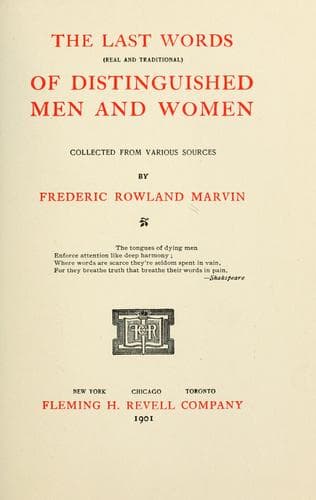
The Last Words (Real and Traditional) of Distinguished Men and WomenMarvin, Frederic Rowland
History
The Last Words (Real and Traditional) of Distinguished Men and Women
Marvin, Frederic Rowland
Last words
After the death of Joanna Southcott, her followers refused to believe
her dead, and consented to a postmortem examination of her body, only
when decomposition had actually commenced. After her burial they formed
themselves into a religious society which they called the Southcottian
church, and professed to believe that she would rise from the dead and
bring forth the promised Shiloh.
SPINOZA (Baruch, his Hebrew name which he translated into Latin as
Benedictus), 1632-1677. There can be no certainty with regard to the
last hours of Spinoza. There was with him at the time of his death but
one friend who refused to make any disclosure, and who chose to pass to
his own grave in silent possession of the secret. Nevertheless a report
prevailed, and was for a time believed, that Spinoza died in great fear
and distress of mind, and that with his last breath he cried out: "_God
have mercy upon me, and be gracious to me, a miserable sinner!_" Another
report, equally without foundation, represented the great Dutch
philosopher as resorting to suicide when he saw death drawing near.
Spinoza is regarded as the ablest of modern pantheistic philosophers.
Dugald Stewart goes so far as to call him an Atheist: "In no part of
Spinoza's works has he avowed himself an Atheist; but it will not be
disputed by those who comprehend the drift of his reasonings, that, in
point of practical tendency, Atheism and Spinozism are one and the
same." During his life he awakened in the minds of some of the ablest
men of letters and religion a bitter hatred it is now difficult to
understand. It is but fifty years ago that Karel Luinman, at that time
minister of the Reformed church at Middleburg, said: "Spit on that
grave--there lies Spinoza." Later Froude, Lewes and Maurice have
described him as a calm, brave man who lived nobly, and confronted
disease and death with a deeply religious faith. Coleridge pronounced
the Pantheism of Spinoza preferable to modern Deism, which he held to be
but "the hypocrisy of Materialism." Schleiermacher vindicated the memory
of the great philosopher after the following fashion: "Offer up
reverently with me a lock of hair to the manes of the rejected but holy
Spinoza! The great Spirit of the Universe filled his soul; the Infinite
to him was beginning and end; the Universal his sole and only love.
Dwelling in holy innocence and deep humility among men, he saw himself
mirrored in the eternal world, and the eternal world not all unworthily
reflected back in him. Full of religion was he, full of the Holy Ghost;
and therefore it is that he meets us standing alone in his age, raised
above the profane multitude, master of his art, but without disciples
and the citizen's rights." Probably the truth of the matter is that
Spinoza was a man of pure, brave and simple life; of gentle disposition;
and of rare philosophical abilities and attainments; but whose system,
though possessed of much that is true and good, is yet essentially
Public-domain text, read in full here on John Shaqi.
Reviews
Reviews
No reviews yet
Be the first to share your thoughts on this work.
Elsewhere in the archive
Join the Discussion
Join the discussion
Sign in to leave a comment or review.
Sign InorCreate an account