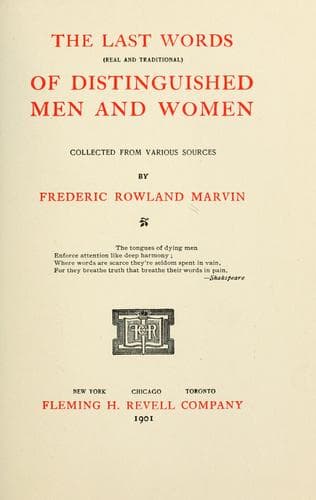
The Last Words (Real and Traditional) of Distinguished Men and WomenMarvin, Frederic Rowland
History
The Last Words (Real and Traditional) of Distinguished Men and Women
Marvin, Frederic Rowland
Last words
STANLEY (Arthur Penrhyn, Dean of Westminster, and the leader of the
"Broad Church" party), 1815-1881. "_So far as I have understood what the
duties of my office were supposed to be, in spite of every incompetence,
I am yet humbly trustful that I have sustained before the mind of the
nation the extraordinary value of the Abbey as a religious, national and
liberal institution._" Later he said: "_The end has come in the way in
which I most desired it should come. I could not have controlled it
better. After preaching one of my sermons on the beatitudes, I had a
most violent fit of sickness, took to my bed, and said immediately that
I wished to die at Westminster. I am perfectly happy, perfectly
satisfied; I have no misgivings._" His last recorded words were: "_I
wish Vaughan to preach my funeral sermon, because he has known me
longest._"
STEELE (Miss Anne, the author of many beautiful and familiar hymns),
1716-1778: "_I know that my Redeemer liveth._" The following lines are
inscribed on her tomb:
Silent the lyre, and dumb the tuneful tongue,
That sung on earth her dear Redeemer's praise;
But now in heaven she joins the angelic song,
In more harmonious, more exalted lays.
STEPHEN (first Christian martyr), "_Lord, lay not this sin to their
charge._"--_Acts vii: 60._
STEVENS (Thaddeus, American statesman and opponent of slavery; a man of
great ability and nobleness of spirit), 1793-1868.
Two colored clergymen called and asked leave to see Stevens and pray
with him. He ordered them to be admitted; and when they had come to his
bedside, he turned and held out his hand to one of them. They sang a
hymn and prayed. During the prayer he responded twice, but could not be
understood. Soon afterward the Sisters of Charity prayed, and he seemed
deeply affected. The doctor told him that he was dying. He made a motion
with his head, but no other reply. One of the sisters asked leave to
baptize him, and it was granted, but whether by Stevens or his nephew is
not clear. She performed the ceremony with a glass of water, a portion
of which was poured upon his forehead. The end came before the beginning
of the next day. He lay motionless for a few moments, then opened his
eyes, took one look, placidly closed them, and, without a struggle, the
great commoner had ceased to breathe.
_Samuel W. McCall: "Life of Stevens."_
On his monument reared over his grave are inscribed by his direction,
these words: "I repose in this quiet and secluded spot, not from any
natural preference for solitude, but finding other cemeteries limited as
to race by charter rules, I have chosen this, that I might illustrate in
my death the principles which I advocated through a long life, (the)
equality of Man before his Creator."
Public-domain text, read in full here on John Shaqi.
Reviews
Reviews
No reviews yet
Be the first to share your thoughts on this work.
Elsewhere in the archive
Join the Discussion
Join the discussion
Sign in to leave a comment or review.
Sign InorCreate an account