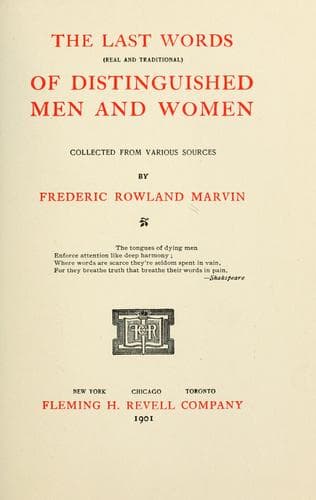
The Last Words (Real and Traditional) of Distinguished Men and WomenMarvin, Frederic Rowland
History
The Last Words (Real and Traditional) of Distinguished Men and Women
Marvin, Frederic Rowland
Last words
[49] It was commonly believed that the immortal soul escaped from
the dead body through the mouth. Sometimes it passed out under the
form of a bird, and sometimes it seemed to be a vapor. The
appearance of the departing soul is mentioned as a known fact, by
the celebrated mystic, Jacob Boehmen, in his curious book. "_The
Three Principles_," where it is described as that of "a blue vapor
going forth out of the mouth of a dying man, which maketh a strong
smell all over the chamber."
THOREAU (Henry David, American author and naturalist), 1817-1862. "_I
leave this world without a regret._"
He was bred to no profession; and it is said that he never went to
church, never voted, and never paid a tax to the state though he was
imprisoned for not doing so. He ate no flesh, drank no wine, never knew
the use of tobacco, and never (though a naturalist) used either trap or
gun.--_Emerson._
He lived in the simplest manner; he sometimes practised the business of
land-surveyor. In 1845 he built a small frame house on the shore of
Walden Pond, near Concord, where he lived two years as a hermit, in
studious retirement. He published an account of this portion of his
life, in a small book entitled "Walden."--_Lippincott._
Thoreau was a kind and good man, but a multitude of eccentricities
separated him from the average life of man and removed him from the
common sympathy of his race. His little house on the shore of Walden
Pond he constructed with his own hands, because he thought that men
should be able to do as much as the birds who build their own nests. The
entire house cost him less than thirty dollars; and in it he lived at an
expense of about twenty-seven cents a week. The house had neither lock
nor curtain, and was unprotected day and night. The door was seldom
closed, and the window was often wide-open in the midst of a winter
storm. "I am no more lonely," he wrote, "than Walden Pond itself. What
company has that, I pray? And yet it has not the blue devils, but blue
angels in it, in the azure tint of its waters." It is said that he could
tell the day of each month by the trees and flowers.
THURLOW (Edward, Lord Chancellor in the reign of George III.),
1732-1806. "_I'll be shot if I don't believe I'm dying._"
TIBERIUS (Claudius Nero, Roman Emperor), B. C. 42--A. D. 37. Finding
himself dying, he took his signet ring off his finger, and held it
awhile, as if he would deliver it to somebody; but put it again on his
finger, and lay for some time, with his left hand clenched, and without
stirring; when suddenly summoning his attendants, and no one answering
the call, he rose; but his strength failing him, he fell down at a short
distance from his bed.--_Seneca._
He died without appointing his successor, but the people cared little
for that. They rejoiced at his death, and ran through the streets of
Rome crying, "Away with Tiberius to the Tiber."
Public-domain text, read in full here on John Shaqi.
Reviews
Reviews
No reviews yet
Be the first to share your thoughts on this work.
Elsewhere in the archive
Join the Discussion
Join the discussion
Sign in to leave a comment or review.
Sign InorCreate an account