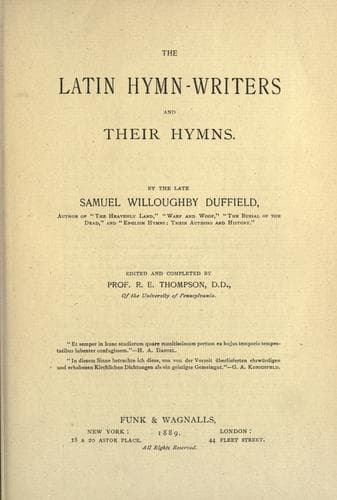
The Latin Hymn-writers and Their HymnsDuffield, Samuel Willoughby
Religion
The Latin Hymn-writers and Their Hymns
Duffield, Samuel Willoughby
Hymns, Latin -- History and criticism
Now it has never been established that Charles was even a ready writer
of prose, to say nothing of verse. Berington, following Einhard,
Charles’s secretary, says in his _History of the Literature of the
Middle Ages_ (1814), that Charles was not a literary man. “He seems
never to have acquired the easy practice of writing,” is his strong
language (p. 102). The hymn, on the contrary, bears the evident marks of
accustomed skill and practice in the art of verse as well as the
accuracy of a mind trained in theologic discriminations. Moreover, if
Maitland (he of the Dark Ages) is to be credited, then this life of the
Blessed Notker, by Ekkehard Junior, is full of errors, of ignorance, and
wilful design. It naturally celebrates whatever is likely to add to the
credit of St. Gall. Hence we need not be astonished when it tells us
that Notker composed the sequence, _Spiritus Sancti adsit nobis gratia_,
and sent it to Charles the Great, receiving in return his composition
the _Veni, Creator Spiritus_. Nor should we be surprised when this turns
out (as it is now conceded to be) a mere legend without any historic
basis. When Thomasius follows this story, and Daniel follows Thomasius,
and Trench follows Daniel, and the compilers follow Trench, it really
appears that but little independent judgment has been exercised on the
subject.
Notker died in 912, and as Charles the Great was dead in 814, the absurd
anachronism of the Ekkehard legend is clear to a glance. It should
perhaps be added that Trench, although allowing Charles as author,
believes the hymn to be possibly of earlier date.
Mone takes a new departure when he gives up the common opinion and
announces that the hymn ought to be assigned to Gregory the Great
(540-606). In his first volume he taxes Daniel with having been
altogether too prompt to agree to the cardinal’s dictum. He finds no
reason to give the hymn to Charles, but he regards the classical style
of its composition to be very fitting to the culture and well-known
powers of Gregory. He rejects the doxology _Sit laus_, etc., and
considers, very justly, that the stanza _Per te sciamus_, etc., is the
true conclusion of the hymn.
Wackernagel agrees with Mone. He thinks that the only way in which
Charles could have secured the authorship would have been by getting the
composition effected by the intervention of Alcuin. He therefore
believes that Gregory was the poet of the _Veni, Creator_, and so
publishes it in his exhaustive work upon the German church hymns.
Professor March, always careful and scholarly in his assignments, adopts
this opinion also.
Public-domain text, read in full here on John Shaqi.
Reviews
Reviews
No reviews yet
Be the first to share your thoughts on this work.
Elsewhere in the archive
Join the Discussion
Join the discussion
Sign in to leave a comment or review.
Sign InorCreate an account