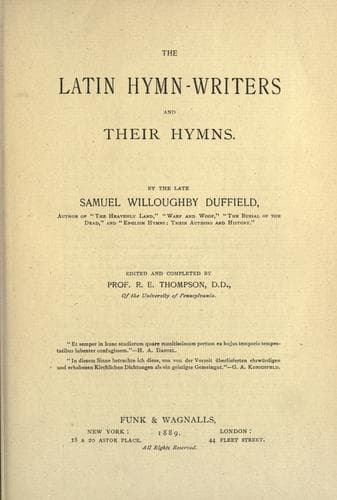
The Latin Hymn-writers and Their HymnsDuffield, Samuel Willoughby
Religion
The Latin Hymn-writers and Their Hymns
Duffield, Samuel Willoughby
Hymns, Latin -- History and criticism
This very singular construction of clauses is apparent to the eye at
once. Let it be remembered that Robert uses it nowhere else, and that
the most of Hermann’s writings are gone. This chance for the “higher
criticism” is therefore taken from us. If it could be shown, however,
that this was a method employed by the monk of Reichenau in his prose
works, the case might be regarded as absolutely proven, in so far as it
demonstrates that the bulk of the presumptive evidence is in his favor.
But here we are at fault. We can only add probability to probability and
leave all absolute demonstration alone. Pez has preserved not merely
Egon’s account of Hermann’s life, but he has edited Hermann’s treatises
on the astrolabe (_Thes. Anecdot. Tom._, III., pt. 2, p. 94) from a MS.
codex in the monastery of St. Peter at Salzburg. His musical treatise is
reprinted by Gerbert. (_Scriptores Eccl. de Musica_, vol. ii., p. 124.)
The didactic poem reciting the combat of the Sheep and the Flax—always
recognized as the production of Hermann—is in Migne’s _Patrologia_ and
also in Du Meril’s _Poesies Populaires_. Unfortunately none of these
writings are of a sort to help us. We cannot by their assistance make
any headway in critical analysis.
It is noticeable that J. A. Fabricius in his great work on the Middle
Age and later Latin writers, allows Hermann to be the author of the
_Veni Sancte_, following the testimony of Egon and Metzler. And it is
more than noticeable that Du Meril—himself a Frenchman—should also
apparently concede the hymn to this German.[9]
I have made an exhaustive search for everything bearing upon the life
and writings of Hermannus Contractus. I have pursued him and Robert
through the _Quellen_ of German history; through the writings and
compilations of Canisius and Despont and Urstitius and Martene and
Mabillon and D’Achery and Pertz and the _Monumenta Germaniae Historica_
of the “Society for Opening the Sources of German History.” In these and
in the encyclopaedias of La Rousse and Ersch-Gruber and the great
_Patrologia_ of Migne, I have investigated every by-path and blind
alley. It is abundantly clear that he was the most distinguished man of
his region, and, likely, of his period. Usserman and Possevin have
devoted attention to him. (_Prodromus Germ. Sacr. Tom._ I., p. 145
_sqq._, _De Apparatu_.) His didactic poem on the “Eight Principal Vices”
is in Haupt’s _Zeitschrift_, vol. xiii. His lives of Conrad and of Henry
III. have not been preserved. That he was a very voluminous writer is
also evident. After giving the names of some of his sequences Metzler
adds that there were _cetera mille alia_—a thousand more. So also speaks
Trithemius; and indeed this testimony is universal.
Public-domain text, read in full here on John Shaqi.
Reviews
Reviews
No reviews yet
Be the first to share your thoughts on this work.
Elsewhere in the archive
Join the Discussion
Join the discussion
Sign in to leave a comment or review.
Sign InorCreate an account