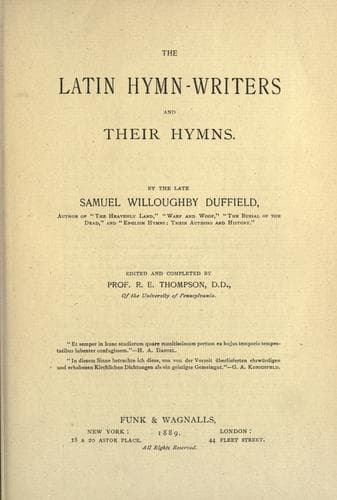
The Latin Hymn-writers and Their HymnsDuffield, Samuel Willoughby
Religion
The Latin Hymn-writers and Their Hymns
Duffield, Samuel Willoughby
Hymns, Latin -- History and criticism
Abelard himself, however, was a genuine educator, and many bishops and
other ecclesiastics, with nineteen cardinals and two popes, came from
the ranks of his pupils. He loved liberty, although he loved it to that
extent to which his own will—and no other authority, human or
divine—restricted it. In this he differed from Anselm of Canterbury, who
loved liberty, not according to license but according to law. Mere
freedom to inquire, to complain, or to theorize, does not invariably
carry with it profitable results. And Abelard—whose very freedom was in
itself a noble revelation to the shackled intellects of his
age—committed the grave error of supposing that the sweep of a free hand
would certainly give lines of beauty and forms of grace. Something
deeper than the mere distaste of false opinions is needful for this.
Art, meditation, truth—all must lie beneath the O of Giotto or the
masterly strokes of Apelles. And our rhetorician would have done well to
have confined himself to the _Trivium_—grammar, rhetoric, and
dialectics. When he undertook theology he first quarrelled with Anselm
of Laon, and next he encountered all Christendom and Bernard of
Clairvaux. His was the fatal blunder of every “free inquirer” who
forgets reverence, and who, in his pride of intellect, may likely fall
as the angels fell. Surely no Lucifer ever plunged more swiftly down
from heaven’s battlements than did poor Peter Abelard from the dizzy
height of his sudden success.
This is no place to criticise his “system,” if system it can be properly
called. The _Sic et Non_—“Yes and No”—his most famous work, is really a
mere challenge. He quotes the Bible against the Fathers and the Fathers
against the Bible, touching on deep tideways and bogs and quicksands
which he never attempts to ford, fathom, or bridge. The Arians,
Sabellians, Nestorians and Pelagians are resuscitated in these pages. He
flings their doubts before us like a gauntlet cast into the arena of
debate. One may choose which side he will take. Such a man, arising in
the nineteenth century and claiming sympathy with Christianity, would be
by some suspected as a secret enemy and his vanity would loosen his
armor for the entrance of many a venomed shaft. His genuine ardor would
be misunderstood and his opinions would be heavily attacked before they
could deploy at their full strength. If this be true to-day how
infinitely more true must it have been of an age narrower, more
illiterate, and with an arm which wielded not in vain the sword of
excision against heretics!
Public-domain text, read in full here on John Shaqi.
Reviews
Reviews
No reviews yet
Be the first to share your thoughts on this work.
Elsewhere in the archive
Join the Discussion
Join the discussion
Sign in to leave a comment or review.
Sign InorCreate an account