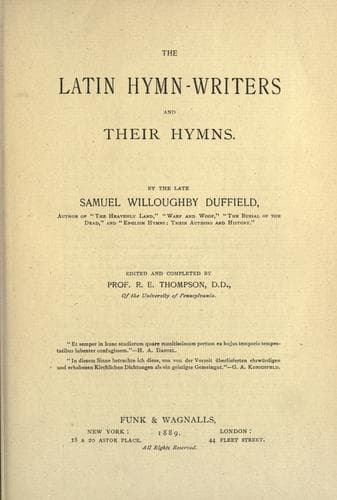
The Latin Hymn-writers and Their HymnsDuffield, Samuel Willoughby
Religion
The Latin Hymn-writers and Their Hymns
Duffield, Samuel Willoughby
Hymns, Latin -- History and criticism
Adam’s peculiarities are very marked in this production. He alludes, as
you perceive, to the Cross in the air which Constantine took as his sign
in which to conquer. He refers to Chosroes, King of Persia, who, after
great successes and the conquest of Jerusalem itself, was finally
overcome by Heraclius, the Eastern Emperor, about 622-29 A.D.; and he
also drags in a piece of mystical imagery about the “four-squareness” of
the earth, which is hard enough to understand without a key. The key is
one with many wards. It includes the “breadth, depth, length, and
height” of the love of Christ; it suggests the appearance of the
heavenly city of John’s vision; it reminds us of the temple in Ezekiel’s
prophecy, and of the account of the actual structure in 1 Kings; it
recalls the classical geographers’ notions about the shape of the earth
and about the “four quarters,” which we still call east, west, north,
south; it finally symbolizes all these things by the four arms of the
Cross! Is it any wonder that Adam of St. Victor is a difficult poet to
translate, and that his verses are not fitted to be sung?
Yet it must not be forgotten that the _Heri mundus exultavit_ (St.
Stephen’s Day) and the _Veni, Creator Spiritus, Spiritus Recreator_, are
both his. Nor must it escape notice that Dr. Neale’s _Mediaeval Hymns_
contains eleven versions of Adam of St. Victor; while Dr. Washburn,
Chancellor Benedict, and other translators have quite made the old
schoolman’s “sequences” and “proses” familiar to the most careless eye.
Recently also we have the three volumes of Mr. Digby S. Wrangham
(London, 1881) in which our poet is translated entire, the Latin and
English being placed upon opposite pages. He has attained such an
eminence as Drummond of Hawthornden, who has come back to us because he
knew Ben Jonson and had kept and stratified the spirit of his age.
To me the man is always fascinating, always suggestive. He appears to
challenge the best that we moderns can do. His very terseness is a
defiance. And here, in this strange symmetry, I fancy that I see the
alertness and skill of that wise insect which takes hold with her hands
in kings’ palaces. The web of this precise and unvarying artisan often
sparkles with the morning dew of a pure devotion. The lines and stays
and braces and fashioning of these illustrious verses are as accurate as
the spider’s spinning. I look up toward the light and, yonder, upon some
Corinthian capital of the song of songs—or over there in a corner of the
gate called Beautiful through which Ezekiel walks—or again, high amid
the wisdom of that Solomon’s Porch of the Apocalypse where stands the
serene John—there I see how Adam of St. Victor has stretched his web.
And if, now and then, some dead fly of an obscure allusion, or some
desiccated bit of monasticism, offends the sight, I strive to think only
of the art that has spread the fabric—and God’s glorious sunshine
brightens, upon His own temple, His little creature’s toil!
Public-domain text, read in full here on John Shaqi.
Reviews
Reviews
No reviews yet
Be the first to share your thoughts on this work.
Elsewhere in the archive
Join the Discussion
Join the discussion
Sign in to leave a comment or review.
Sign InorCreate an account