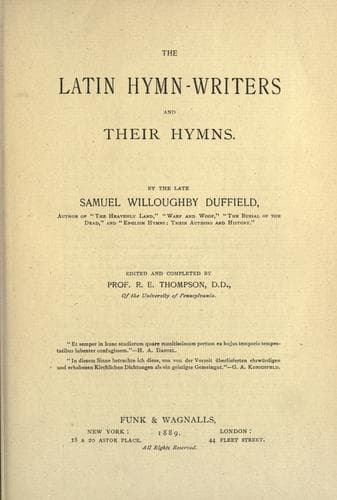
The Latin Hymn-writers and Their HymnsDuffield, Samuel Willoughby
Religion
The Latin Hymn-writers and Their Hymns
Duffield, Samuel Willoughby
Hymns, Latin -- History and criticism
It is with the Breviary, however, that hymnology is especially
concerned, as it is in it that the hymns of the Church are mostly to be
found, while the sequences belong to the Missal. It contains the prayers
said in the Church’s behalf every day at the canonical hours by the
priests and the members of the religious orders. Originally there were
only three of these canonical hours, and they were based on Old
Testament usage. These were at the third, sixth, and ninth hour of the
Scriptures (nine o’clock, noon, and three in the afternoon), and in the
Western Church are called Tierce, Sext, and Nones, for that reason. The
number afterward was increased to five and then to seven. To these three
day hours were added three night hours, with two at the transition from
night to day (Prime), and from day to night (Vespers). But to get up
thrice in the night was too much for even monastic discipline, so they
said two night services together at midnight, and then they slept till
dawn. As this daily service differs in its contents according to the
seasons of the Church year, and also is adapted to the commemoration of
the saints of the Calendar, the Breviary is the most voluminous
prayer-book known to Christendom. It generally is published in four
substantial volumes, one each for the four natural seasons. It is used
in such public services as are not accompanied by a celebration of any
sacrament and in the choir service of the religious houses. In theory,
however, the Church is present even at the solitary recitation of the
hours by a secular priest; and when two say them in company they must
say them aloud.
Hymns were not in the services of the Breviary from the beginning. As
late as the sixth century there was a controversy as to admitting
anything but the words of Scripture to be sung. We find a Gallic synod
sanctioning their use, and a Spanish synod taking common ground with our
Psalm-singing Presbyterians. But in the next century even Spain, through
the Council of Toledo (A.D. 633), appeals to early precedent in behalf
of hymns, and decides that if people may use uninspired words in prayer,
they may do the same in their praises—_Sicut ergo orationes, ita et
hymnos in laudem Dei compositos nullus vestrum ulterius improbet_—which
went to the core of the question and silenced the exclusive
Psalm-singers. Twenty years later another Council of Toledo required of
candidates for orders that they should know both the Psalter and the
hymns by heart. Yet in the Roman Breviary no hymns were introduced
before the thirteenth century, when Haymo, the General of the Franciscan
Order, reformed it in 1244 with the sanction of Gregory IX. and Nicholas
III.
Public-domain text, read in full here on John Shaqi.
Reviews
Reviews
No reviews yet
Be the first to share your thoughts on this work.
Elsewhere in the archive
Join the Discussion
Join the discussion
Sign in to leave a comment or review.
Sign InorCreate an account