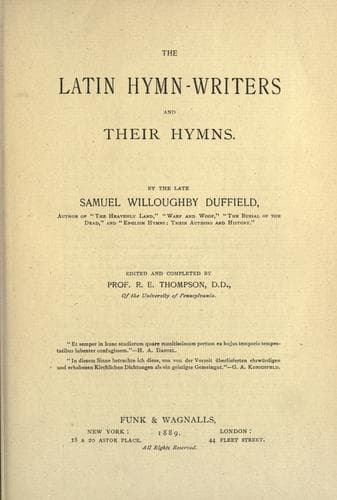
The Latin Hymn-writers and Their HymnsDuffield, Samuel Willoughby
Religion
The Latin Hymn-writers and Their Hymns
Duffield, Samuel Willoughby
Hymns, Latin -- History and criticism
Daniel in his first volume prints fifty-five of these recasts in
parallel columns with the originals, and to that we will refer our
readers for further specimens. It is gratifying to know that not all the
scholarship of that age was insensible to the qualities which the
revisers sacrificed. Henry Valesius, although only a layman and a lover
of good Latin—as his versions of the historians of the early Church
show—uttered a fierce but ineffectual protest in favor of the early and
mediaeval hymns. And the Marquis of Bute, a convert to Catholicism, who
published an English translation of the Breviary in 1879, says that the
revisers of 1602 “with deplorable taste made a series of changes in the
texts of the hymns, which has been disastrous both to the literary merit
and the historical interest of the poems.” He hopes for a further
revision which shall undo this mischief, but in other respects return to
the type furnished by the Breviary of Quiñonez.
The translations from the hymns of the Roman Breviary have been very
abundant. Those by Protestants have been due to the fact that the texts
even of ancient hymns were so much more accessible in their Breviary
version than in their original form. Among Roman Catholics, of course,
other considerations have weight; and in Mr. Edward Caswall’s _Lyra
Catholica_ and Mr. Orby Shipley’s _Annus Sanctus_ will be found some
very admirable versions. The latter book is an anthology from the Roman
Catholic translators from John Dryden to John Henry Newman.
From the Breviary text Mr. Duffield has made the following translations
of two hymns by Gregory the Great:
JAM LUCIS ORTO SIDERE.
Now with the risen star of dawn,
To God as suppliants we pray,
That he may keep us free from harm,
And guide us through an active day.
May he, restraining, guard the tongue,
Lest it be found to strive and cry,
And, lest it drink in vanities,
May he protect the wayward eye.
Let all our inmost thoughts be pure,
And heedlessness of heart be gone;
Let self-denying drink and food
Hold pride and flesh securely down,
That when the day at length is past,
And night in turn has come to men,
Through abstinence from earth, we may
Give thee the only glory then.
To God the Father be the praise,
And to his sole-begotten Son,
And to the Holy Paraclete,
Now and until all time be done.
ECCE JAM NOCTIS TENUATUR UMBRA.
Lo, now, the shadows of the night are breaking,
While in the east the rising daylight brightens,
Therefore with praises will we all adore thee,
Lord God Almighty!
How doth our God, commiserating mortals,
Drive away sorrow, offering them safety,
Since he shall give us, through paternal kindness,
Rule in the heavens!
This let the blessed Deity afford us,
Father and Son and equal Holy Spirit,
Whose through the earth be glory in all places
Ever resounding.
Public-domain text, read in full here on John Shaqi.
Reviews
Reviews
No reviews yet
Be the first to share your thoughts on this work.
Elsewhere in the archive
Join the Discussion
Join the discussion
Sign in to leave a comment or review.
Sign InorCreate an account