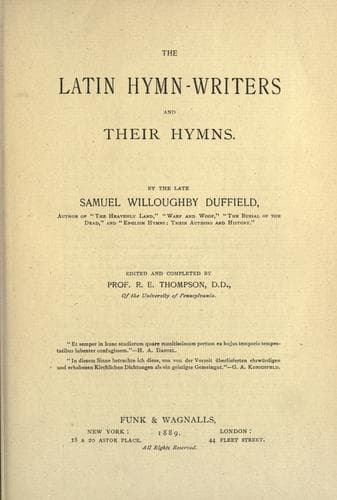
The Latin Hymn-writers and Their HymnsDuffield, Samuel Willoughby
Religion
The Latin Hymn-writers and Their Hymns
Duffield, Samuel Willoughby
Hymns, Latin -- History and criticism
“Damasus and Ursinus being eager beyond measure to secure possession
of the bishop’s seat, carried on the conflict most bitterly and with
divisive partisanship, their supporters carrying their quarrels to the
point of inflicting death and wounds. As Juventius was unable either
to suppress or abate these evils, he yielded to the violence and
withdrew to the suburbs. And in the struggle Damasus overcame, as his
party was the more determined of the two. It is admitted that in the
basilica of Sicinus, which is a place of assemblage for Christian
worship, there were found in one day one hundred and thirty-seven
corpses of those who had been done to death; and also that the
excitement of the populace abated slowly and with difficulty after the
affair was over.”
“See how these Christians love one another!” was a comment made by
pagans on the spirit which had prevailed in the earlier Church. They now
might have said it ironically. It is impossible to acquit Damasus of all
responsibility in the matter, as he was a man of eminent ability and
influence, and might have put an end to these scenes of violence if he
had exerted his authority. It is equally impossible to believe that he
took any part in them. Then, as in the Reformation times, what John Knox
calls “the raskill multitude” greatly enjoyed an opportunity to show how
great their zeal for religion, in any other shape but that of obeying
its precepts. “Set Jehu to pulling down idols,” said an old Puritan,
“and see how zealous he can be.”
The schism did not end with the bloody struggle around the basilica of
St. Sicinus. It is true that the civil authority now interposed and
banished the bishop of the Luciferian party. But he afterward was
allowed to return, and again the troubles revived and ceased only with
his second banishment. Even when the Emperor Gratian gave Damasus the
entire jurisdiction over the bishops and priests involved in the schism,
with a view to the final suppression of these disputes, the extremists
lingered on. After Ursicinus there was yet another Luciferian bishop of
Rome; and by a curious freak of controversial zeal the memory of Felix
was consecrated as that of an opponent of Liberius, and a mythical
account of their relations was given currency, which has resulted in the
elevation of Felix to the rank of “pope and martyr,” on the ground that
Constantius had him beheaded for his loyalty to the Nicene faith![2]
Public-domain text, read in full here on John Shaqi.
Reviews
Reviews
No reviews yet
Be the first to share your thoughts on this work.
Join the Discussion
Join the discussion
Sign in to leave a comment or review.
Sign InorCreate an account