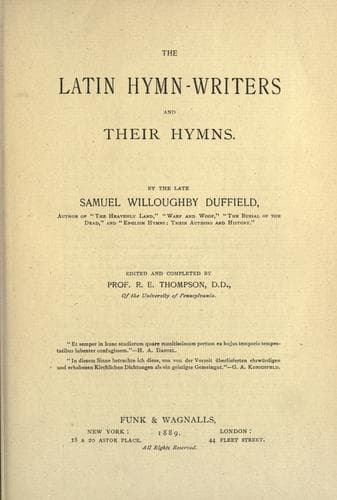
The Latin Hymn-writers and Their HymnsDuffield, Samuel Willoughby
Religion
The Latin Hymn-writers and Their Hymns
Duffield, Samuel Willoughby
Hymns, Latin -- History and criticism
Damasus made an excellent record in his see, after the abating of the
troubles which attended his accession to it. He left no room for doubt
as to his orthodoxy. For the first time since the great controversy
broke out in Alexandria, the whole weight and influence of the great
Roman see was thrown unreservedly and effectively on the Athanasian
side. The accession of Valentinian (364-75) to the imperial authority in
the West once more threw the weight of court influence on the other
side; but intolerance was not carried to the same extent as by
Constantius. At every stage of the discussion we find Damasus outspoken
on behalf of the Nicene faith, and in support of Athanasius. In 368 he
held a synod at Rome, in which the Illyrian bishops Ursacius and Valens,
who were trying to Arianize the West, were condemned as heretics; and in
370 another in which the same condemnation was meted out to Auxentius,
the Bishop of Milan. Before he died he saw the second General Council
meet at Constantinople and lay the ban of the Church on all the
compromises with Arianism.
The see of Rome already had become a place of great splendor and
influence. “Make me Bishop of Rome,” the pagan senator Praetextatus said
to him, “and I will be a Christian to-morrow.” Damasus seems to have
enjoyed the pomp and show and opportunities for outlay and for influence
which his position secured him. But there was much in his administration
of his diocese which commends him to our sympathies and even our
admiration. He seems to have been the first to have taken a genuine
interest in the Catacombs—the great underground burial-places which are
so rich in memorials of the Church’s primitive and martyr ages. He
fostered their use as places of pilgrimage and reunion for the people of
his own diocese and pilgrims from others. He constructed the staircases
which made them accessible, the well-lights for their illumination and
ventilation, and the chapels for collective worship. Here Christendom,
in the day of its triumph, gathered to commemorate those who had been
faithful when the Church was under the cross, and Prudentius in his
_Peristephanon_ has left us a lively picture of the eager multitudes who
resorted thither on the festival days, some from Rome itself, others
from the Etrurian and Sabine villages, thronging even the great roads to
the city to their utmost capacity: “From early morn they press thither
to greet the saints. The multitude comes and goes until evening. They
kiss the polished plates of silver which cover the grave of the martyr.
They offer incense, and tears of emotion stream from the eyes of all.”
Public-domain text, read in full here on John Shaqi.
Reviews
Reviews
No reviews yet
Be the first to share your thoughts on this work.
Join the Discussion
Join the discussion
Sign in to leave a comment or review.
Sign InorCreate an account