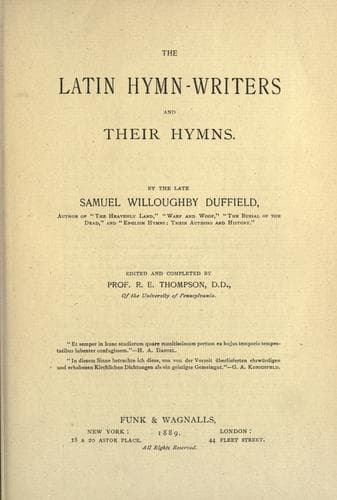
The Latin Hymn-writers and Their HymnsDuffield, Samuel Willoughby
Religion
The Latin Hymn-writers and Their Hymns
Duffield, Samuel Willoughby
Hymns, Latin -- History and criticism
In the mean time three years of exile to Thrace, where he was thrown of
set purpose into constant association with bishops of the semi-Arian
party, and isolated from his friends, had broken the spirit of Liberius.
He was not a man of strong character, and, unfortunately for the theory
of papal infallibility, he yielded. He signed a creed compiled for the
occasion, which described Christ as of _like_ substance with the Father,
and condemned Athanasius.[1] He then was allowed to return to Rome,
although Felix II. was still the recognized bishop. Constantius seems to
have foreseen the difficulties which would attend the presence of the
two bishops in the city, and he consented to the return of Liberius
unwillingly. The body of the people and of the clergy at once rallied
around Liberius, and rejected Felix altogether; and of this party was
Damasus. But while they were willing to condone his weakness in the
matter of condemning Athanasius, there was a party of more determined
Athanasians who refused to do so, and the diocese now was divided
between the three factions. That of Felix disappeared with his own death
in 360 and the death of Constantius in 361. But the extreme Athanasians,
although they did not attempt to set up a rival bishop while Liberius
lived, perpetuated their party, and they probably received aid and
comfort from a similar party which had arisen in the East, in opposition
to the wiser and more charitable policy of Athanasius himself. This
party was called the Luciferians, from Lucifer, Bishop of Cagliari, in
Sardinia, who was in exile in the East at the time when this question
was raised there after the death of Constantius.
In 367 Liberius died, and the schism at once showed itself in Rome.
Damasus was chosen and ordained bishop in the regular form by the
friends of Liberius, who were the great majority. But the Deacon
Ursicinus was chosen by the Luciferian party, and ordained by bishops of
that party in the basilica of St. Sicinus. Unfortunately the prefect of
the city was a weak and ineffective man, who was quite unable to
preserve peace between the two factions. It soon came to blows between
them, and the pagan historian, Ammianus Marcellinus, tells us with what
result:
Public-domain text, read in full here on John Shaqi.
Reviews
Reviews
No reviews yet
Be the first to share your thoughts on this work.
Join the Discussion
Join the discussion
Sign in to leave a comment or review.
Sign InorCreate an account