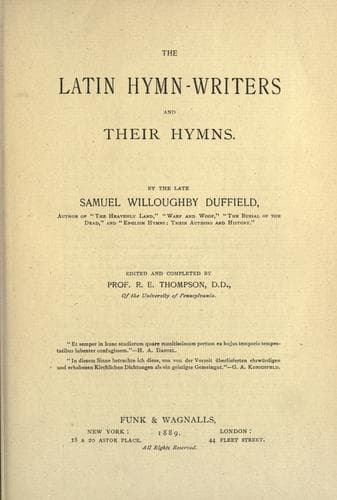
The Latin Hymn-writers and Their HymnsDuffield, Samuel Willoughby
Religion
The Latin Hymn-writers and Their Hymns
Duffield, Samuel Willoughby
Hymns, Latin -- History and criticism
‘Haec Damasi tibi, Christe Deus, nova tecta levavi
Laurenti saeptus martyris auxilio.’
“Mention of Damasus’s Archives is frequently made in the documents of
the fourth and fifth centuries. Jerome calls them _chartarium ecclesiae
Romanae_.”[3]
But a still more lasting monument of his fame is the Latin Vulgate,
which he incited Jerome—as the English-speaking world calls Sophronius
Eusebius Hieronymus—to prepare for the Church of the West. From a very
early time Latin translations of the Scriptures from the Greek version
of the Old Testament and the Greek original of the New Testament had
been in existence. But although there were two well recognized types of
these early versions—the Italian and the African—there was so little
uniformity that there were “almost as many versions as copies.” Jerome
was a man of classical culture and a close student of the Scriptures,
which he could read in Hebrew as well as in Greek and Latin. He came to
Rome from Syria in 382, to ask the aid of Damasus in behalf of the
Luciferian schism at Antioch—a matter in which the Bishop of Rome hardly
could meddle. Even before his arrival he had been in correspondence with
Damasus and had written for him an exposition of the vision of the
Seraphim in Isaiah 6. Damasus called a synod in which the schism at
Antioch was discussed, but no result reached. It is said that in this
synod he exhorted Jerome to take up the work of giving the Church a good
Latin version of the Bible. A ninth-century writer says he put him in
charge of the _Archivum_, or public library, described by Professor
Lanciani. Later writers speak of him, without much warrant, as Damasus’s
secretary. It seems probable that Damasus regarded him as a desirable
man for the bishopric when his own death should leave it vacant. But
when his death came in 384, the Dalmatian scholar was passed over,
perhaps because he was not a Roman, and a much smaller man than either
Damasus or Jerome was chosen instead. So Jerome went back to the East
and established himself at Bethlehem. Between 382 and 404 he completed
his version of the Scriptures, which is of especial importance to the
student of Latin hymnology, as it stands in much the same relation to
the Latin hymns of the fifth and later centuries as does the English
Bible to the English hymn-writers. It controls their vocabulary and
explains their allusions.
As a poet Damasus does not take very high rank. We have seen Professor
Lanciani’s opinion of his inscriptions. Some forty poems are attributed
to him, but only a very few of these concern us here. In the Cottonian
MSS. there is a copy of rhymed “Verses of Damasus to his Friend”
(_Versus Damasi ad Amicum suum_), which would be interesting to us if we
were sure that Sir Alexander Croke is right in assuming that this is our
Damasus. But the name “Rainalde” in the first line would hardly occur in
a Latin poem by a Roman author of the fourth century.
Public-domain text, read in full here on John Shaqi.
Reviews
Reviews
No reviews yet
Be the first to share your thoughts on this work.
Join the Discussion
Join the discussion
Sign in to leave a comment or review.
Sign InorCreate an account