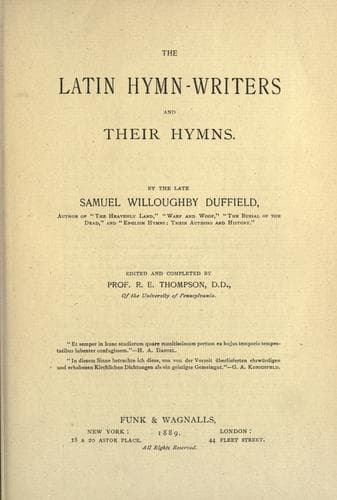
The Latin Hymn-writers and Their HymnsDuffield, Samuel Willoughby
Religion
The Latin Hymn-writers and Their Hymns
Duffield, Samuel Willoughby
Hymns, Latin -- History and criticism
When, after long centuries of forgetfulness, the Catacombs were reopened
in 1578 by Antonio Bosio, traces of these pilgrimages were found in the
_graffiti_ or rude chalk-inscriptions left on the walls of the passages
by the Italian peasants of the fourth and fifth centuries. There also
were found the inscriptions in verse, composed by Damasus, and cut in
stone by his friend, Furius Filocalus, who devised an ornamental
alphabet for the purpose. In one of these Filocalus describes himself as
one who “reverenced and loved Pope Damasus” (_Damasi papae cultor atque
amator_).
Another side of his activity has been brought into light by more recent
researches in Rome. Professor Lanciani says that to Damasus belongs also
the honor of having founded the first public library of Christendom:
“The finest libraries of the first centuries of Christendom were, of
course, in Rome.... Such was the importance attributed to books in those
early days of our faith that, in Christian basilicas, or places of
worship, they were kept in the place of honor—next to the episcopal
chair. Many of the basilicas which we discover from time to time,
especially in the Campagna, have the _apse trichora_—that is, divided
into three small hemicycles. The reason of this peculiar form was long
sought in vain; but a recent discovery made at Hispalis proves that of
the three hemicycles the central one contained the tribunal or episcopal
chair, the one on the right the sacred implements, the one on the left
the sacred books.
“The first building erected in Rome, under the Christian rule, for the
study and preservation of books and documents, was the _Archivum_
(Archives) of Pope Damasus. This just and enterprising pope, the last
representative of good old Roman traditions as regards the magnificence
and usefulness of his public structures, modelled his establishment on
the pattern of the typical library at Pergamos; of which the Palatine
Library in Rome had been the worthy rival. He began by raising in the
centre a hall of basilical type, which he dedicated to St. Lawrence,”
and which “was surrounded by a square portico, into which opened the
rooms or cells containing the various departments of the archives and of
the library.” A commemorative inscription, composed by Damasus himself,
in hexameters, seven in number, was set in front of the building above
the main entrance. The text has been discovered in a MS. formerly at
Heidelberg, now in the Vatican. The first four hexameters do not bring
out in a good light the poetical faculties of the worthy pontiff—in fact
their real meaning has not yet been ascertained; but the last three
verses are more intelligible:
‘Archibis, fateor, volui nova condere tecta;
Addere praeterea dextra laevaque columnas,
Quae Damasi teneant proprium per saecula nomen.’
“Around the apse of the inner hall there was another distich of about
the same poetical value, the text of which has been discovered in a MS.
at Verdun:
Public-domain text, read in full here on John Shaqi.
Reviews
Reviews
No reviews yet
Be the first to share your thoughts on this work.
Join the Discussion
Join the discussion
Sign in to leave a comment or review.
Sign InorCreate an account