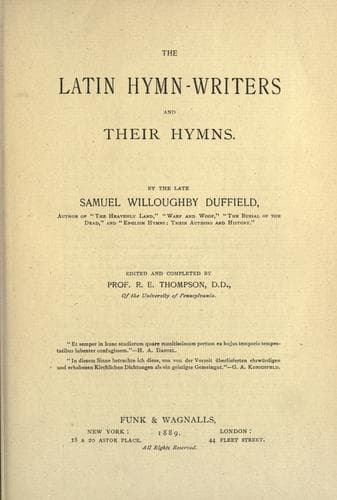
The Latin Hymn-writers and Their HymnsDuffield, Samuel Willoughby
Religion
The Latin Hymn-writers and Their Hymns
Duffield, Samuel Willoughby
Hymns, Latin -- History and criticism
It would appear that the Ambrosian hymns obtained much of their earliest
recognition in Spain. At least so runs the statement of Cardinal
Thomasius, who edited the Mozarabic (Spanish) Breviary. He says: “It is
not doubtful that in the seventh century of the Church, when the Spanish
Church especially flourished, the Ambrosian hymns were everywhere in
vogue.” The _Concilium Agathense_ (Council of Agde in Southern France,
A.D. 506), which concerned itself chiefly with matters of discipline,
ordained that hymns should be sung morning and evening, and at the
conclusion of matins, vespers, and masses. These and similar enactments
had reference to the body of hymns which had received the name of the
Bishop of Milan. Then, as now, they formed the true fragrant cedar-heart
of the old psalmody, and it is from their structure that the Council of
Toledo (633) drew its famous definition. The Council said: “_Proprie
autem hymni sunt continentes laudem Dei. Si ergo sit laus, et non sit
Dei, non est hymnus. Si sit et laus Dei laus_ [_sic_] _et non cantatur
non est hymnus. Si ergo laudem Dei dicitur et cantatur, tunc est
hymnus._” That is to say: “Hymns properly contain the praise of God. If
therefore there be praise, but not of God, this is no hymn. If there be
praise, praise of God, but not capable of being sung, this is no hymn.
If therefore the praise of God be both composed and sung, it is then a
hymn.”
The author who is thus honored as the first great leader of the Church’s
praise was born at Treves, in Gaul, about the year 340 (or, as some say,
334). His father was a Roman noble who became praetorian prefect of the
province of Gallia Narbonensis; and as Hither Gaul was an important
region, it can be easily seen that the young Ambrose was reared in the
midst of wealth and power. His mother was a learned woman and he
naturally imbibed letters as he grew up. A tradition, which is probably
based on fact, assures us that even in his cradle he was marked for
fame. A swarm of bees came down upon him, and the amazed nurse saw them
clustered about his very mouth without harming him. This was the same
prodigy which had been related of Plato, and hence his parents imagined
a high destiny for the lad. It was indeed a singular and suggestive
commentary on his future life. He preserved his equanimity amid a great
deal of buzzing; and the sweetness of his speech won to him no less a
convert than the great Augustine. His entire career was worthy of the
sainted Sotheria, his ancestress, who was martyred for the faith under
Diocletian.
Public-domain text, read in full here on John Shaqi.
Reviews
Reviews
No reviews yet
Be the first to share your thoughts on this work.
Elsewhere in the archive
Join the Discussion
Join the discussion
Sign in to leave a comment or review.
Sign InorCreate an account