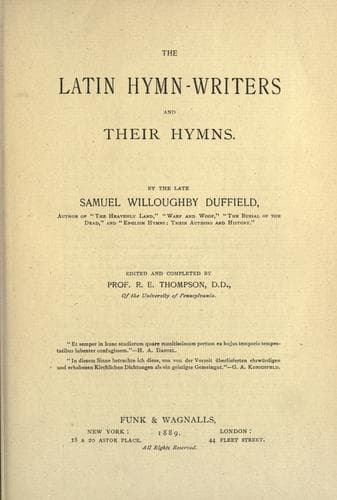
The Latin Hymn-writers and Their HymnsDuffield, Samuel Willoughby
Religion
The Latin Hymn-writers and Their Hymns
Duffield, Samuel Willoughby
Hymns, Latin -- History and criticism
He appears to us a man of both character and conscience. His education
was given him at Rome, and his brother Satyrus and himself went to Milan
to practice at the bar. His success as a pleader was great. He became
first assessor to the prefect with the rank of _Consularis_, whose
headquarters were now at Milan; and subsequently he took charge of
Liguria and Emilia. For in 369 we find him, by appointment of the
Emperor Valentinian, prefect of Upper Italy and Milan. His position is
sometimes styled that of “consular,” sometimes that of “governor,” and
sometimes that of “praetor” or imperial president, which last perhaps
the easiest designation for modern ears and carries the plainest meaning
with it.
Now Milan was the capital of Liguria and it was the business of the
praetor to preside in the stead of the Emperor over the choice of a
bishop. Auxentius, an Arian, who had held this office, died in 374 and a
new election was necessary. This was not an easy matter, for the feud
between the Catholics and the Arians was at fever-heat, and rioting and
bloodshed were very certain to occur.
The praetor called to mind the advice of Probus, prefect of Italy, who
had once charged him to administer the affairs of his region “like a
bishop.” He therefore tried to cast oil upon the waters. His genial
gravity and calm serenity of spirit aided the impression he meant to
produce. Both factions gazed upon him with delight. His attitude was so
unpartisan as to charm everybody, and it was very natural that this
eloquent representative of the Emperor should carry the suffrages of the
throng. And just when the interest was most intense and the confidence
greatest, a child cried out, “Let Ambrose be bishop,” and the crowd
caught the contagion at once.
In later days it was maliciously said that Ambrose had himself contrived
this scene with an eye to the stage effect—that for all his apparent
humility the coming bishop set store by the office and wanted to obtain
it—that, in short, his reluctance to receive it and even his precipitate
flight from the city were prearranged! More than this, it has been
asserted that the various schemes and subterfuges to avoid becoming
bishop were known to and abetted by his friends, who were of the
orthodox party and desired to have their candidate elected. The best
reply that can be given is the character of the man himself. Such a
person must have entertained the highest reverence for such an office.
In his administration of its cares and duties he showed a conscious
supremacy over every worldly consideration. In his final acceptance of
it he evinced no less of self-denial than of sincerity. And it is
incredible that so mighty a mind as that of Augustine could have been
caught by the glittering emptiness of a hypocritical or self-seeking
nature. We may well charge these calumnies to their proper
sources—those, namely, of disappointed ambition or of envious malignity.
Public-domain text, read in full here on John Shaqi.
Reviews
Reviews
No reviews yet
Be the first to share your thoughts on this work.
Elsewhere in the archive
Join the Discussion
Join the discussion
Sign in to leave a comment or review.
Sign InorCreate an account