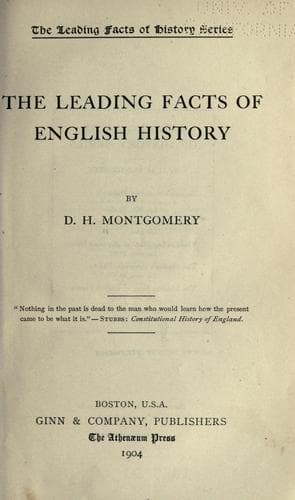
The Leading Facts of English HistoryMontgomery, D. H. (David Henry)
History
The Leading Facts of English History
Montgomery, D. H. (David Henry)
Great Britain -- History
After a long truce, war again broke out. Philip VI had died, and his
son, John II, now sat on the French throne. Edward, during this
campaign, ravaged northern France. The next year his son, the Black
Prince (S238), marched from Bordeaux into the heart of the country.
Reaching Poitiers with a force of ten thousand men, he found himself
nearly surrounded by a French army of sixty thousand. The Prince so
placed his troops amidst the narrow lanes and vineyards, that the
enemy could not attack him with their full strength. Again the
English archers gained the day (S238), and King John himself was taken
prisoner and carried in triumph to England. (See map facing p. 128.)
242. Peace of Bre'tigny, 1360.
The victory of Poitiers was followed by another truce; then war began
again. Edward intended besieging Paris, but was forced to retire to
obtain provisions for his troops. Negotiations were now opened by the
French. While these great negotiations were going on, a terrible
thunderstorm destroyed great numbers of men and horses in Edward's
camp.
Edward, believing it a sign of the displeasure of Heaven against his
expedition, fell on his knees, and within sight of the Cathedral of
Chartres vowed to make peace. A treaty was accordingly signed at
Bre'tigny near by. By it, Edward renounced his claim to Normandy and
the French crown. But notwithstanding that fact, all English
sovereigns insisted on retaining the title of "King of France" down to
a late period of the reign of George III. France, on the other hand,
acknowledged the right of England, in full sovereignty, to the country
south of the Loire, together with Calais, and agreed to pay an
enormous ransom in pure gold for the restoration of King John.
243. Effects of the French Wars in England.
The great gain to England from these wars was not in the territory
conquered, but in the new feeling of unity they aroused among all
classes. The memory of the brave deeds achieved in those fierce
contests on a foreign soil never faded out. The glory of the Black
Prince (SS238, 241), whose rusted helmet and dented shield still hang
above his tomb in Canterbury Cathedral,[1] became one with the glory
of the plain bowmen, whose names are found only in country
churchyards.
[1] This is probably the oldest armor of the king in Great Britain.
See Stothard's "Monumental Effigies."
Henceforth, whatever lingering feeling of jealousy and hatred had
remained in England, between the Norman and the Englishman (S192), now
gradually melted away. An honest, patriotic pride made both feel that
at last they had become a united and homogeneous people.
Public-domain text, read in full here on John Shaqi.
Reviews
Reviews
No reviews yet
Be the first to share your thoughts on this work.
Elsewhere in the archive
Join the Discussion
Join the discussion
Sign in to leave a comment or review.
Sign InorCreate an account