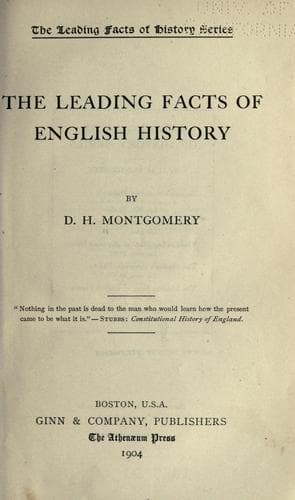
The Leading Facts of English HistoryMontgomery, D. H. (David Henry)
History
The Leading Facts of English History
Montgomery, D. H. (David Henry)
Great Britain -- History
[1] In Scotland, villeinage lasted much longer, and as late as 1774,
in the reign of George III, men working in coal and salt mines were
held in a species of slavery, which was finally abolished the
following year.
So long as he was a serf, the peasant could claim assistance from his
master in sickness and old age; in attaining independence he had to
risk the danger of pauperism, which began with it,--this possibility
being part of the price which man must everywhere pay for the
inestimable privilege of freedom.
253. The New Movement in Literature, 1390 (?).
The same spirit which demanded emancipation on the part of the working
classes showed itself in literature. We have already seen (S246) how,
in the previous reign, Langland, in his poem of "Piers Plowman," gave
bold utterance to the growing discontent of the times in his
declaration that the rich and great destroyed the poor.
In a different spirit, Chaucer, "the morning star of English song,"
now began (1390?) to write his "Canterbury Tales," a series of stories
in verse, supposed to be told by a merry band of pilgrims on their way
from the Tabard Inn in Southwark, London, to the shrine of St. Thomas
Becket in Canterbury (S170).
There is little of Langland's complaint in Chaucer, for he was
generally a favorite at court, seeing mainly the bright side of life,
and sure of his yearly allowance of money and daily pitcher of wine
from the royal bounty. Yet, with all his mirth, there is a vein of
playful satire in his description of men and things. His pictures of
jolly monks and easy-going churchmen, with his lines addressed to his
purse as his "saviour, as down in this world here," show that he saw
beneath the surface of things. He too was thinking, at least at
times, of the manifold evils of poverty and of that danger springing
from religious indifference which poor Langland had taken so much to
heart.
254. Wycliffe; the First Complete English Bible, 1378.
But the real reformer of that day was John Wycliffe, rector of
Lutterworth in Leicestershire and lecturer at Oxford (S246). He
boldly attacked the religious and the political corruption of the
age. The "Begging Friars," who had once done such good work (S208),
had now grown too rich and lazy to be of further use.
Wycliffe, whose emaciated form concealed an unconquerable energy and
dauntless courage, organized a new band of brothers known as "Poor
Priests." They took up and pushed forward the reforms the friars had
dropped. Clothed in red sackcloth cloaks, barefooted, with staff in
hand, they went about from town to town[1] preaching "God's law," and
demanding that Church and State bring themselves into harmony with it.
[1] Compare Chaucer's
"A good man ther was of religioun,
That was a poure persone [parson] of a town."
Prologue to the "Canterbury Tales" (479)
Public-domain text, read in full here on John Shaqi.
Reviews
Reviews
No reviews yet
Be the first to share your thoughts on this work.
Elsewhere in the archive
Join the Discussion
Join the discussion
Sign in to leave a comment or review.
Sign InorCreate an account