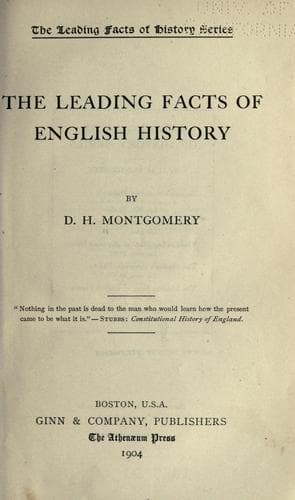
The Leading Facts of English HistoryMontgomery, D. H. (David Henry)
History
The Leading Facts of English History
Montgomery, D. H. (David Henry)
Great Britain -- History
Later in the period the knights of the shire joined the
representatives from the towns in forming a distinct body in
Parliament, sitting by themselves under the name of the House of
Commons. They asserted their right to assent to legislation, and
(1376) they exercised hte right of impeaching before the House of
Lords government officers guilty of misuse of power. Somewhat later
(1407) they obtained the sole right to originate "Money Bills," that
is, grants or appropriations of money for public purposes or for the
King's use.
263. New Class of Barons.
Under Henry III other influential men of the realm, aside from the
barons, who were tenants in chief, began to be summoned to the King's
council. These were called "barons by writ." Later (under Richard
II), barons were created by open letters bearing the royal seal, and
were called "barons by patent."[1]
[1] This is the modern method of raising a subject (e.g. the poet,
Alfred Tennyson) to the peerage. It marks the fact that from the
thirteenth century the ownership of land was no longer considered a
necessary condition of nobility; and that the peerage was gradually
developing into the five degrees, which were completed in 1440, in the
following ascending order: barons, viscounts, earls, marquises, dukes.
264. Land Laws.
During this period important laws (De Donis, or Entail, and Quia
Emptores) respecting land were passed, which had the effect of keeping
estates in families, and also of preventing their possessors from
evading their feudal duties to the King. At the same time the Statute
of Mortmain (a restriction on the acquisition of land by the Church,
which was exempt from paying certain feudal dues) was imposed to
prevent the King's revenue from being diminished.
II. Religion
265. Restriction of Papal Power.
During the Angevin period the popes endeavored to introduce the canon
law (a body of ordinances consisting mainly of the decisions of Church
councils and popes) into England, with the view of making it supreme;
but the Parliament of Merton refused to accept it, saying, "We will
not change the laws of England."
The Statute of Mortmain was also passed (SS226, 264) and other
measures (Statutes of Provisors and Statute of Praemunire) (S243),
which forbade the Pope from taking the appointment of bishops and
other ecclesiastics out of the hands of the clergy; and which
prohibited any appeal from the King's Court to the Papal Court.
Furthermore, many hundreds of parishes, formerly filled by foreigners
who could not speak English, were now given to native priests, and the
sending of money out of the country to support foreign ecclesiastics
was in great measure stopped.
Public-domain text, read in full here on John Shaqi.
Reviews
Reviews
No reviews yet
Be the first to share your thoughts on this work.
Elsewhere in the archive
Join the Discussion
Join the discussion
Sign in to leave a comment or review.
Sign InorCreate an account