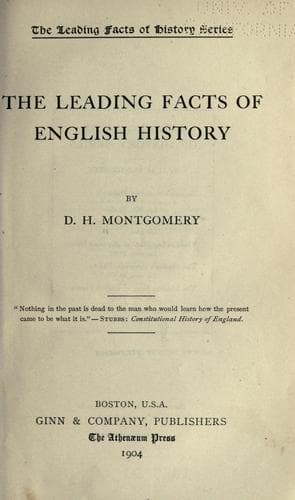
The Leading Facts of English HistoryMontgomery, D. H. (David Henry)
History
The Leading Facts of English History
Montgomery, D. H. (David Henry)
Great Britain -- History
[2] This right of originating "Money Bills" had been claimed as early
as the reign of Richard II, but was not fully and formally recognized
until 1407. See Taswell-Langmead's "English Constitutional History,"
p. 260, and Summary of Constitutional History in the Appendix, p. xii,
S13.
He had no clear title to the throne, and he had no means to buy
military support. In addition to these difficulties, he had made an
enemy of Sir Henry Percy. He had refused to ransom his
brother-in-law, a Mortimer,[3] whom Glendower had captured, but whom
the King wished well out of the way with others of that name.
[3] Sir Edmund Mortimer: He was uncle to the Edmund Mortimer, Earl of
March, who was heir to the crown. See Bailey's "Succession to the
English Crown."
Young Percy proved a dangerous foe. His hot temper and impetuous
daring had got for him the title of the "Hotspur of the North." He
was so fond of fighting that Shakespeare speaks of him as "he that
kills me osme six or seven dozen of scots at a breakfast, washes his
hands, and says to his wife, Fie upon this quite life! I want
work."[1] This "fire eater," with his father, his uncle (the Earl of
Worcester), the Scotch Earl of Douglas, and, last of all, Owen
Glendower, now formed an alliance to force Henry to give up the
throne.
[1] Shakespeare's "Henry IV," Part I, Act II, scene iv.
282. Battle of Shrewsbury (1403).
At Shrewsbury, on the edge of Wales, the armies of the King and of the
revolutionists met. A number of Henry's enemies had sworn to single
him out in battle. The plot was divulged, and it is said that
thirteen knights arrayed themselves in armor resembling the King's in
order to mislead the assailants. The whole thirteen perished on that
bloody field, where fat Sir John Falstaff vowed he fought on Henry's
behalf "a long hour by Shrewsbury clock."[2]
[2] Shakespeare's "Henry IV," Part I, Act V, scene iv.
283. Persecution of the Lollards; Statute of Heresy; the First Martyr
(1401).
Thus far Henry had spent much time in crushing rebels, but he had also
given part of it to burning heretics. To gain the favor of the
clergy, and so render his throne more secure, the King favored the
passage of a Statute of Heresy. The Lords and bishops passed such a
law (to which the House of Commons seems to have assented).[3] It
punished the Lollards (S255) and also all others who dissented from
the essential doctrines of Rome with death.
[3] See Stubb's "Constitutional History of England," III, 32.
William Sawtrey, a London clergyman, was the first victim under the
new law (1401). He had declared that he would not worship "the cross
on which Christ suffered, but only Christ himself who had suffered on
the cross." He had also openly denied the doctrine of
transubstantiation, which teaches that the sacramental bread is
miraculously changed into the actual body of the Saviour. For these
and minor heresies he was burned at Smithfield, in London, in the
presence of a great multitude.
Public-domain text, read in full here on John Shaqi.
Reviews
Reviews
No reviews yet
Be the first to share your thoughts on this work.
Elsewhere in the archive
Join the Discussion
Join the discussion
Sign in to leave a comment or review.
Sign InorCreate an account