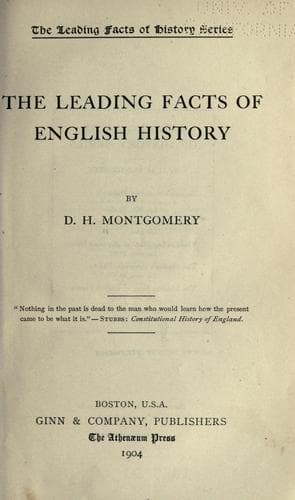
The Leading Facts of English HistoryMontgomery, D. H. (David Henry)
History
The Leading Facts of English History
Montgomery, D. H. (David Henry)
Great Britain -- History
Richard used the preparations which had been made for the murdered
Prince Edward's coronation for his own (S310). He probably gained
over an influential party by promises of financial reform. In their
address to him at his accession, Parliament said, "Certainly we be
determined rather to adventure and commit us to the peril of our
lives...than to live in such thraldom and bondage as we have lived
long time heretofore, oppressed and injured by extortions and new
impositions, against the laws of God and man, and the liberty, old
policy and laws of this realm, wherein every Englishman is
inherited."[1]
[1] Taswell-Langmead's "Constitutional History of England."
313. Richard III's Character.
Several attempts have been made of late years to defend the King
against the odium heaped upon him by the older historians. But these
well-meant efforts to prove him less black than tradition painted him
are answered by the fact that his memory was thoroughly hated by those
who knew him best. No one of the age when he lived thought of
vindicating his character. He was called a "hypocrite" and a
"hunchback."
We must believe then, until it is clearly proved to the contrary, that
the last of the Yorkist kings was what common report and Shakespeare
have together represented him,[2]--distorted in figure, and with
ambition so unrestrained that the words the great English poet has
seen fit to put into his mouth may have really expressed Richard's own
thought:
"Then, since the heavens have shap'd my body so,
Let hell make crookt my mind to answer it."[1]
[2] In this connection it may be well to say a word in regard to the
historical value of Shakespeare's utterances, which have been freely
quoted in this book. He generally followed the Chronicles of Hall and
Holinshed, which constitute two important sources of information on
the periods of which they treat; and he sometimes followed them so
closely that he simply turned their prose into verse. Mr. James
Gairdner, who is a high authority on the Wars of the Roses, calls
Shakespeare "an unrivaled interpreter" of that long and terrible
conflict. (See the preface to his "Houses of Lancaster and York.")
In the preface to his "Richard III" Mr. Gairdner is still more
explicit. He says: "A minute study of the facts of Richard's life has
tended more and more to convince me of the general fidelity of the
portrait with which we have been made familiar by Shakespeare and Sir
Thomas More." On Shakespeare's faithful presentation of history see
also A.G.S. Canning's "Thoughts on Shakespeare," p. 295; the
Dictionary of National (British) Biography under "Holinshed"; Garnett
and Gosse's "English Literature," Vol. II, p. 68; and H.N. Hudson's
"Shakespeare's Life and Characters," Vol. II, pp. 5-8. See, too,
S298, note 1.
[1] Shakespeare's "Henry VI," Part III, Act V, scene vi.
Public-domain text, read in full here on John Shaqi.
Reviews
Reviews
No reviews yet
Be the first to share your thoughts on this work.
Elsewhere in the archive
Join the Discussion
Join the discussion
Sign in to leave a comment or review.
Sign InorCreate an account