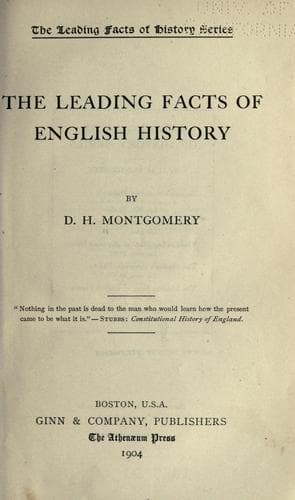
The Leading Facts of English HistoryMontgomery, D. H. (David Henry)
History
The Leading Facts of English History
Montgomery, D. H. (David Henry)
Great Britain -- History
The long bow continued to be the chief arm of the foot soldiers, and
was used with great dexterity and fatal effect. Targets were set up
by law in every parish, and the yeomen were required to practice
frequently at contests in archery. The principle wars were the civil
wars and those with France.
IV. Literature, Learning, and Art
322. Introduction of Printing; Books.
The art of printing was introduced into England about 1477 by Caxton,
a London merchant. Up to that time all books had been written on
either parchment or paper, at an average rate of about fifty cents per
page in modern money. The age was not favorable to literature, and
produced no great writers; but Caxton edited and published a large
number of works, many of which he translated from the French and
Latin.
The two books which throw most light on the history of the times are
the "Sir John Paston Letters" (1424-1506), and a work by Chief Justice
Fortescue on government, intended for the use of Prince Edward (slain
at Tewkesbury). The latter work is remarkable for its bold
declaration that the King "has the delegation of power from the
people, and he has no just claims to any other power than this." The
chief justice also praises the courage of his countrymen, and declares
with honest pride that "more Englishmen are hanged in England in one
year for robbery and manslaughter than are hanged in France in seven
years."
323. Education.
Henry VI took a deep interest in education, and founded the great
public school of Eton, which ranks next in age to that of Winchester.
The money for its endowment was obtained by the appropriation of the
revenues of alien or foreign monasteries which had been erected in
England, and which were confiscated by Henry V. The King watched the
progress of the building from the windows of Windsor Castle, and to
supplement the course of education to be given there, he furthermore
erected and endowed the magnificent King's College, Cambridge.
324. Architecture.
There was a new development of Gothic architecture in this period, the
Decorated giving place to the Perpendicular. The latter derives its
name from the perpendicular divisions of the lights in the arches of
the windows. It marks the final period of the Gothic or Pointed
style, and is noted for the exquisite carved work of its ceilings.
King's College Chapel, Cambridge, St. George's Chapel, Windsor, and
Henry VII's Chapel (built in the next reign), connected with
Westminster Abbey, are among the most celebrated examples of this
style of architecture, whic his peculiar to England.
The mansions of the nobility at this period exhibited great elegance.
Crosby Hall, London, at one time the residence of Richard III, was one
of the best examples of the "Inns" of the great families and wealthy
knights. The Hall was pulled down in 1903, but it has been reerected
on the Chelsea Embankment, on the Thames.
V. General Industry and Commerce
325. Agriculture and Trade.
Public-domain text, read in full here on John Shaqi.
Reviews
Reviews
No reviews yet
Be the first to share your thoughts on this work.
Elsewhere in the archive
Join the Discussion
Join the discussion
Sign in to leave a comment or review.
Sign InorCreate an account