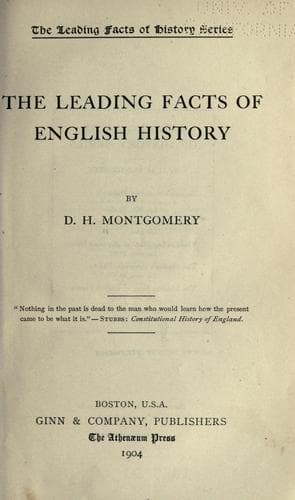
The Leading Facts of English HistoryMontgomery, D. H. (David Henry)
History
The Leading Facts of English History
Montgomery, D. H. (David Henry)
Great Britain -- History
The true significance of Henry's reign is, that it, in like manner,
stands for a new epoch,--new in modes of government, in law, in
geographical discovery, in letters, art, and religion.
The century just closing was indeed one of the most remarkable in
history, not only in what it had actually accomplished, but still more
in the seed it was sowing for the future. The celebrated German
artist Kaulbach, in his fresco of "The Age of the Reformation," has
summed up all that it was, and all that it was destined to become in
its full development.
Therein we see it as the period which witnessed the introduction of
firearms, and the consequent overthrow of feudal warfare and feudal
institutions; the growth of the power of royalty and of nationality
through royalty; the sailing of Columbus and of Cabot; the revival of
classical learning; the publication of the first printed book; and
finally, the birth of Martin Luther, the monk who broke away from the
Catholic Church, and persuaded many people to become Protestants.
337. Summary.
Looking back, we find that with Henry VII the absolutism of the Crown,
or "personal monarchy," began in England. Yet the repressive power of
that "personal monarchy" procured peace for the English people and,
despite "benevolences" and other exactions, they grew into a stronger
national unity.
Simultaneously with this increase of royal authority came the
discovery of a "New World," in which England and her colonies were to
have the chief part. A century will elapse before those discoveries
begin to bear fruit. After that, our attention will no longer be
confined to the British Islands, but will be fixed as well on that
western continent where British enterprise and English love of liberty
were destined to find a new and broader field of activity.
Henry VIII--1509-1547
338. Henry's Advantages.
Henry VIII was not quite eighteen when he came to the throne. The
country was at peace, was fairly prosperous, and the young King had
everything in his favor. He was handsome, well educated, and fond of
athletic sports. His frank disposition won friends everywhere, and he
had inherited from his father the largest private fortune that had
ever descended to an English sovereign. Intellectually, he was in
hearty sympathy with the revival of learning, then in progress both on
the Continent and in England.
339. The New Learning; Colet, Erasmus, More.
During the greater part of the Middle Ages the chief object of
education was to make men monks, and originally the schools
established at Oxford and Cambridge were exclusively for that
purpose. In their day they did excellent work; but a time came when
men ceased to found monasteries, and began to erect colleges and
hospitals instead.[1]
[1] In the twelfth century four hundred and eighteen monasteries were
founded in England; in the next century, only about a third as many;
in the fourteenth, only twenty-three; after that date their
establishment may be said to cease.
Public-domain text, read in full here on John Shaqi.
Reviews
Reviews
No reviews yet
Be the first to share your thoughts on this work.
Elsewhere in the archive
Join the Discussion
Join the discussion
Sign in to leave a comment or review.
Sign InorCreate an account