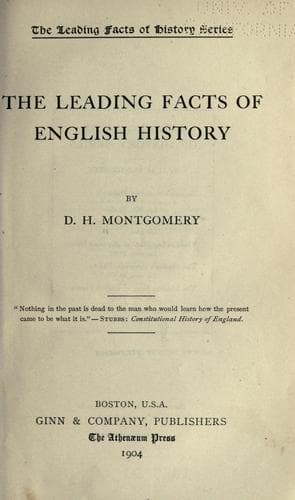
The Leading Facts of English HistoryMontgomery, D. H. (David Henry)
History
The Leading Facts of English History
Montgomery, D. H. (David Henry)
Great Britain -- History
"There was the weight that pulled me down.
... all my glories
In that one woman I have lost forever."[1]
[1] Shakespeare's "Henry VIII," Act III, scene ii.
Thus deprived of well-nigh everything but life, the Cardinal was
permitted to go into retirement in the north; less than a twelve-month
later he was arrested on a charge of high treason. Through the irony
of fate, the warrant was served by a former lover of Anne Boleyn's,
whom Wolsey, it is said, had separated from her in order that she
might consummate her unhappy marriage with royalty. On the way to
London Wolsey fell mortally ill, and turned aside at Leicester to die
in the abbey there, with the words:
"...O, Father Abbot,
An old man, broken with the storms of state,
Is come to lay his weary bones among ye:
Give him a little earth for charity!"[2]
[2] Shakespeare's "Henry VIII," Act IV, scene ii.
347. Appeal to the Universities.
Before Wolsey's death, Dr. Thomas Cranmer, of Cambridge, suggested
that the King lay the divorce question before the universities of
Europe. Henry caught eagerly at this proposition, and exclaimed,
"Cranmer has the right pig by the ear." The scheme was at once
adopted. Several universities returned favorable answers. In a few
instances, as at Oxford and Cambridge, where the authorities
hesitated, a judicious use of bribes or threats soon brought them to
see the matter in a proper light.
348. The Clergy declare Henry Head of the Church, 1531.
Armed with these decisions in his favor, Henry now charged the whole
body of the English Church with being guilty of the same crime of
which Wolsey had been accused (S346). The clergy, in their terror,
made haste to buy a pardon at a cost reckoned at nearly $5,000,000 at
the present value of money.
They furthermore declared Henry to be the supreme head on earth of the
Church of England, adroitly adding, "in so far as is permitted by the
law of Christ." Thus the Reformation came into England "by a side
door, as it were." Nevertheless, it came.
349. Henry marries Anne Boleyn; Act of Supremacy, 1534.
Events now moved rapidly toward a crisis. In 1533, after having
waited over five years, Henry privately married Anne Boleyn (S343),
and she was soon after crowned in Westminster Abbey. When the Pope
was informed of this, he ordered the King, under pain of
excommunication (S194), to put her away, and to take back Queen
Catharine (S345).
Parliament met that demand by passing the Act of Supremacy, 1534,
which declared Henry to be without reservation the sole head of the
Church, making denial thereof high treason.[1] As he signed the act,
the King with one stroke of his pen overturned the traditions of a
thousand years, and England stood boldly forth with a National Church
independent of the Pope.[2]
Public-domain text, read in full here on John Shaqi.
Reviews
Reviews
No reviews yet
Be the first to share your thoughts on this work.
Elsewhere in the archive
Join the Discussion
Join the discussion
Sign in to leave a comment or review.
Sign InorCreate an account