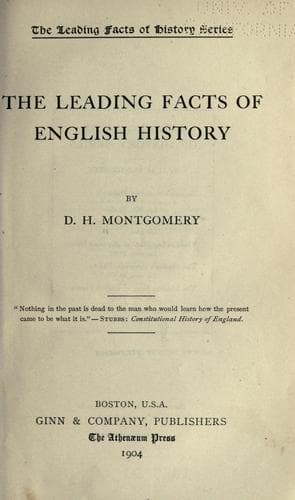
The Leading Facts of English HistoryMontgomery, D. H. (David Henry)
History
The Leading Facts of English History
Montgomery, D. H. (David Henry)
Great Britain -- History
In Scotland the Puritans had got possession of the government, while
in England they were steadily gaining ground. They were ready to
recognize the Queen as head of the Church of England, they even wished
that all persons should be compelled to worship as the government
prescribed, but they protested against what they considered the
halfway form of Church which Elizabeth and the bishops seemed inclined
to maintain.
379. The Queen's Choice of Counselors.
Elizabeth's policy from the beginning was one of compromise. In order
to conciliate the Catholic party, she retained eleven of her sister
Mary's counselors. But she added to them Sir William Cecil (Lord
Burghley), who was her chief adviser,[2] Sir Nicholas Bacon, and,
later, Sir Francis Walsingham, with others who were favorable to the
Protestant faith.
[2] See Macaulay's essay on "Lord Burghley."
On his appointment, Elizabeth said to Cecil, "This judgment I have of
you, that you will not be corrupted with any gifts, that you will be
faithful to the State, and that without respect to my private will you
give me that counsel which you think best." Cecil served the Queen
until his death, forty years afterward. The almost implicit obedience
with which Elizabeth followed his advice sufficiently proves that
Cecil was the real power not only behind, but generally above, the
throne.
380. The Coronation (1559).
The bishops were Roman Catholics, and Elizabeth found it difficult to
get one to perform the coronation services. At length one consented,
but only on condition that the Queen should take the ancient form of
coronation oath, by which she virtually bound herself to support the
Roman Catholic Church.[1] To this Elizabeth consented, and having
consulted an astrologer, Dr. Dee, he named a lucky day for the
ceremony, and she was crowned (1559).
[1] By this oath every English sovereign from William the Conqueror to
Elizabeth, inclusive, and even as late as James II, with the single
exception of Edward VI, swore "to preserve religion in the same state
as did Edward the Confessor." The form of the coronation oath was
changed to support Protestantism by the Revolution of 1688. Finally,
under George V, in 1910, the phraseology of the oath was modified by
Act of Parliament in order to make it less objectionable not only to
English Catholics, but to a large majority of the people of the
nation.
381. Changes in the Church Service (1559).
Public-domain text, read in full here on John Shaqi.
Reviews
Reviews
No reviews yet
Be the first to share your thoughts on this work.
Elsewhere in the archive
Join the Discussion
Join the discussion
Sign in to leave a comment or review.
Sign InorCreate an account