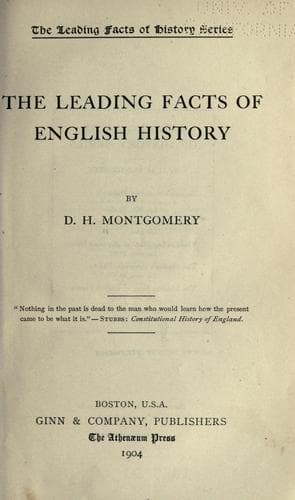
The Leading Facts of English HistoryMontgomery, D. H. (David Henry)
History
The Leading Facts of English History
Montgomery, D. H. (David Henry)
Great Britain -- History
One sees her tomb, with her full-length, recumbent effigy, in the
north aisle of Henry VII's Chapel, Westminster Abbey, while in the
south aisle he sees the tomb and effigy of her old rival and enemy,
Mary Queen of Scots (S397). The sculptured features of both look
placid. "After life's fitful fever they sleep well."
405. Summary.
The Elizabethan period was in every respect remarkable. It was great
in its men of thought, great in its literature, and equally great in
its men of action. It was greatest, however, in its successful
resistance to the armed hand of religious oppression. "Practically the
reign of Elizabeth," as Bishop Creighton remarks, "saw England
established as a Protestant country."[2]
[2] See "The Dictionary of English History" ("The Reformation"),
p. 860.
The defeat of the Spanish Armada in 1588 gave renewed courage to the
cause of the Reformation, not only in England, but in every Protestant
country in Europe. It meant that a movement had begun which, though
it might be temporarily hindered, would secure to all civilized
countries, which accepted it, the right of private judgment and of
liberty of conscience in matters of religion.
General Reference Summary of the Tudor Period (1485-1603)
I. Government II. Religion III. Military Affairs. IV. Literature,
Learning and Art. V. General Industry and Commerce. VI. Mode of
Life, Manners, and Customs
I. Government
406. Absolutism of the Crown; Free Trade; the Post Office.
During a great part of the Tudor period the power of the Crown was
well-nigh absolute. Four causes contributed to this: (1) The
destruction of a very large part of the feudal nobility by the Wars of
the Roses.[1] (2) The removal of many of the higher clergy from the
House of Lords.[2] (3) The creation of a new nobility dependant on the
king. (4) The desire of the great body of the people for "peace at any
price."
[1] In the last Parliament before the Wars of the Roses (1454) there
were fifty-three temporal peers; at the beginning of the reign of
Henry VII (1485) there were only twenty-nine.
[2] Out of a total of barely ninety peers, Henry VIII, by the
suppression of the monasteries, removed upwards of thirty-six abbots
and priors. He, however, added five new bishops, which made the House
of Lords number about fifty-nine.
Under Henry VII and Elizabeth the courts of Star Chamber and High
Commission exercised arbitrary power, and often inflicted cruel
punishments for offenses against the government, and for heresy or the
denial of the religious supremacy of the sovereign.
Henry VII established a treaty of free trade, called the "Great
Intercourse," between England and the Netherlands. Under Elizabeth
the first postmaster-general entered upon his duties, though the post
office was nott fully established until the reign of her successor.
II. Religion
407. Establishment of the Protestant Church of England.
Public-domain text, read in full here on John Shaqi.
Reviews
Reviews
No reviews yet
Be the first to share your thoughts on this work.
Elsewhere in the archive
Join the Discussion
Join the discussion
Sign in to leave a comment or review.
Sign InorCreate an account