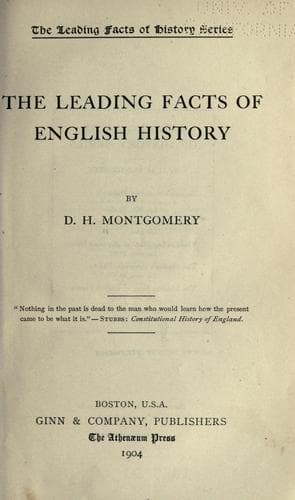
The Leading Facts of English HistoryMontgomery, D. H. (David Henry)
History
The Leading Facts of English History
Montgomery, D. H. (David Henry)
Great Britain -- History
Elizabeth reformed the currency, and ordered the mint to send out coin
which no longer had a lie stamped on its face, thereby setting an
example to all future governments, whether monarchical or republican.
VI. Mode of Life, Manners, and Customs
414. Life in the Country and the City.
In the cities this was an age of luxury; but on the farms the laborer
was glad to get a bundle of straw for a bed, and a wooden trencher to
eat from. Vegetables were scarcely known, and fresh meat was eaten
only by the well to do. The cottages were built of sticks and mud,
without chimneys, and were nearly as bare of furniture as the wigwam
of an American Indian.
The rich kept several mansions and country houses, but paid little
attention to cleanliness; and when the filth and vermin in one became
unendurable, they left it "to sweeten," as they said, and went to
another of their estates. The dress of the nobles continued to be of
the most costly materials and the gayest colors.
At table a great variety of dishes were served on silver plate, but
fingers were still used in place of forks. Tea and coffee were
unknown, and beer was the usual drink at breakfast and supper.
Carriages were seldom used, except by Queen Elizabeth, and most
journeys were performed on horseback. Merchandise was also generally
transported on pack horses, the roads rarely being good enough for the
passage of wagons. The principal amusements were the theater,
dancing, masquerading, bull and bear baiting (worrying a bull or bear
with dogs), cockfighting, and gambling.
Ninth Period[1]
"It is the nature of the devil of tyranny to tear and rend the body
which he leaves."--Macaulay
Beginning with the Divine Right of Kings and Ending with the Divine
Right of the People
King or Parliament?
House of Stuart (1603-1649, 1660-1714)
James I, 1603-1625
Charles I, 1625-1649
"The Commonwealth and Protectorate," 1649-1660
Charles II, 1660-1685
James II, 1685-1689
William and Mary,[2] 1689-1702
Anne, 1702-1714
[1] Reference Books on this Period will be found in the Classified
List of Books in the Appendix. The pronunciation of names will be
found in the Index. The Leading Dates stand unenclosed; all others
are in parentheses.
[2] House of Orange-Stuart.
415. Accession of James I.
Elizabeth was the last of the Tudor family (S376). By birth, James
Stuart, only son of Mary STuart, Queen of Scots, and great-grandson of
Margaret, sister of Henry VIII, was the nearest heir to the crown.[3]
He was already King of Scotland under the title of James VI. He now,
by act of Parliament, became James I of England. By his accession the
two countries were united under one sovereign, but each retained its
own Parliament, its own National Church, and its own laws.[4] The new
monarch found himself ruler over three kingdoms, each professing a
different religion. Puritanism prevailed in Scotland, Catholicism in
Ireland, Anglicanism or Episcopacy in England.
Public-domain text, read in full here on John Shaqi.
Reviews
Reviews
No reviews yet
Be the first to share your thoughts on this work.
Elsewhere in the archive
Join the Discussion
Join the discussion
Sign in to leave a comment or review.
Sign InorCreate an account