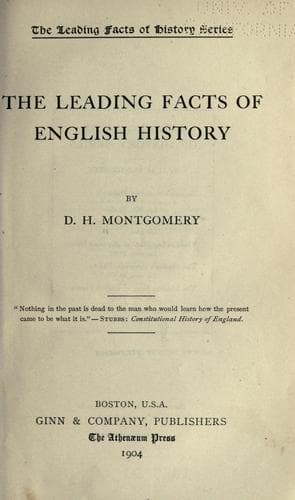
The Leading Facts of English HistoryMontgomery, D. H. (David Henry)
History
The Leading Facts of English History
Montgomery, D. H. (David Henry)
Great Britain -- History
[1] 1648 Old Style would here correspond to 1649 New Style. (See S545,
note 2.)
452. Difficulties of the New Republic.
Shortly after the establishment of the Commonwealth, General Fairfax
(S442) resigned his command, and Cromwell became the sole leader of
the military forces of the country. But the new government, even with
his aid, had no easy task before it.
It had enemies in the Royalists, who, since the King's execution, had
grown stronger; in the Presbyterians, who hated both the "Rump
Parliament" (S450) and the Parliamentary army; finally, it had enemies
in its own ranks, for there were half-crazy fanatics. "Levelers,"[1]
"Come-outers,"[2] and other "cattle and creeping things," who would be
satisfied with nothing but destruction and confusion.
[1] "Levelers": a name given to certain radical republicans who wished
to reduce all ranks and classes to the same level with respect to
political power and privileges.
[2] "Come-outers": those who abandoned all established ways in
government and religion.
Among these there were socialists, or communists, who, like those of
the present day, wished to abolish private property, and establish "an
equal division of unequal earnings," while others declared and acted
out their belief in the coming end of the world. Eventually Cromwell
had to deal with these crack-brained enthusiasts in a decided way,
especially as some of them threatened to assassinate him in order to
hasten the advent of the personal reign of Christ and his saints on
earth.
453. The Late King's Son proclaimed King in Ireland and Scotland;
Dunbar; Worcester (1649-1651).
An attempt of the English Puritan party (S378) to root out Catholicism
in Ireland (1641) had caused a horrible insurrection. The Royalist
party in Ireland now proclaimed Prince Charles, son of the late
Charles I, King. Parliament deputed Cromwell to reduce that country
to order, and to destroy the Royalists. Nothing could have been more
congenial to his "Ironsides" (S445) than such a crusade. They
descended upon the unhappy island (1649), and wiped out the rebellion
in such a whirlwind of fire and slaughter that the horror of the
visitation has never been forgotten. To this day the direst
imprecation a southern Irishman can utter is, "The curse of Cromwell
on ye!"[3]
[3] At Drogheda and Wexford, Cromwell, acting in accordance with the
laws of war of that day, massacred the garrisons that refused to
surrender.
Public-domain text, read in full here on John Shaqi.
Reviews
Reviews
No reviews yet
Be the first to share your thoughts on this work.
Elsewhere in the archive
Join the Discussion
Join the discussion
Sign in to leave a comment or review.
Sign InorCreate an account