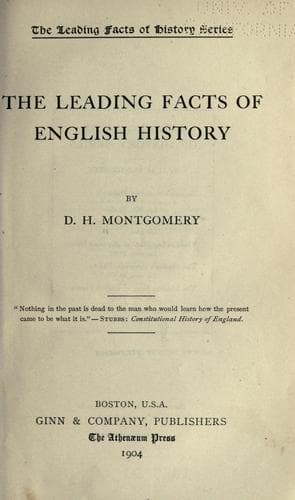
The Leading Facts of English HistoryMontgomery, D. H. (David Henry)
History
The Leading Facts of English History
Montgomery, D. H. (David Henry)
Great Britain -- History
473. Seizure of a Dutch Colony in America (1664).
While these things were going on in England, a strange event took
place abroad. The Dutch had established a colony on the Hudson River.
It was on territory which the English claimed (S335), but which they
had never explored or settled. The Dutch had built a town at the
mouth of the Hudson, which they called New Amsterdam. They held the
place undisturbed for fifty years, and if "Possession is nine points
of the law," they seem to have acquired it. Furthermore, during the
period of Cromwell's Protectorate (S455), England had made a treaty
with Holland and had recognized the claims of the Dutch in the New
World.
Charles had found shelter and generous treatment in Holland when he
needed it most. But he now cooly repudiated the treaty, and, though
the two nations were at peace, he treacherously sent out a secret
expedition to capture the Dutch colony for his brother James, Duke of
York, to whom he had granted it.
One day a small English fleet suddenly appeared (1664) in the harbor
of the Dutch town, and demanded its immediate and unconditional
surrender. The governor was unprepared to make any defense, and the
place was given up. Thus, without so much as the firing of a gun, New
Amsterdam got the name of New York in honor of the man who had now
become its owner. The acquisition of this territory, which had
separated the northern English colonies from the southern, gave
England complete control of the Atlantic coast from Maine to northern
Florida.
474. The Plague and the Fire, 1665, 1666.
The next year a terrible outbreak of the plague occurred in London,
1665, which spread throughout the kingdom (S244). All who could, fled
from the city. Hundreds of houses were left vacant, while on hundreds
more a cross marked on the doors in red chalk, with the words "Lord
have mercy on us," written underneath, told where the work of death
was going on.[1]
[1] Pepys writes in his "Diary," describing the beginning of the
plague: "The 7th of June, 1665, was the hottest day I ever felt in my
life. This day, much against my will, I did in Drury Lane see two or
three houses with a red cross upon the door, and `Lord have mercy upon
us' writ there, which was a sad sight."--Pepys, "Diary," 1660-1669.
Defoe wrote a journal of the plague in 1722, based, probably, on the
reports of eyewitnesses. It gives a vivid and truthful account of its
horrors.
The pestilence swept off over a hundred thousand victims within six
months. Among the few brave men who voluntarily remained in the
stricken city were the Puritan ministers, who stayed to comfort and
console the sick and dying. After the plague was over, they received
their reward through the enforcement of those acts of persecution
which drove them homeless and helpless from their parishes and friends
(S472).
Public-domain text, read in full here on John Shaqi.
Reviews
Reviews
No reviews yet
Be the first to share your thoughts on this work.
Elsewhere in the archive
Join the Discussion
Join the discussion
Sign in to leave a comment or review.
Sign InorCreate an account