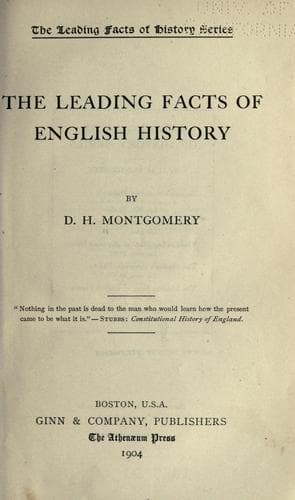
The Leading Facts of English HistoryMontgomery, D. H. (David Henry)
History
The Leading Facts of English History
Montgomery, D. H. (David Henry)
Great Britain -- History
Louis XIV of France, then the most powerful monarch in Europe, wished
to conquer Holland, with the double object of extending his own
kingdom and the power of Catholicism. He saw in Charles the tool he
wanted to gain this end. With the aid of two members of the "Cabal,"
Charles negotiated the secret Treaty of Dover, 1670. Thereby Louis
bribed the English King with a gift of 300,000 pounds to help him
carry out his scheme. Thus, without the knowledge of Parliament,
Charles deliberately sold himself to the French sovereign, who was
plotting to destroy the political liberty and Protestant faith of
Holland.
In addition to the above sum, it was furthermore agreed that Louis
should pay Charles a pension of 200,000 pounds a year from the date
when the latter should openly avow himself a Roman Catholic. Later
(1671), Charles made a sham treaty with Louis XIV in which the article
about his avowing himself a Catholic was omitted in order to deceive
Parliament.[1]
[1] See Summary of Constitutional History in the Appendix, p. xix,
S21.
True to his infamous contract, Charles provoked a new war with the
Dutch, but found that he needed more money to prosecute it
successfully. Not knowing where to borrow, he determined to steal
it. Various London merchants, bankers, and also persons of moderate
means had lent to the government sums of money on promise of repayment
from the taxes.
A part of the national revenue amounting to about 1,300,000 pounds, a
sum equal to at least $10,000,000 now, had been deposited in the
exchequer, or government treasury, to meet the obligation. The King
seized this money,[2] partly for his needs, but chiefly to squander on
his vices, and to satisfy the insatiate demands of his favorites,--of
whom a single one, the Duchess of Portsmouth, had spent 136,000 pounds
within the space of a twelvemonth! The King's treacherous act caused a
financial panic which shook London to its foundatyions and ruined
great numbers of people.
[2] "`Rob me the Exchequer, Hal,' said the King to his favorite
minister in the `Cabal'; then `all went merry as a marriage
bell.'"--Evelyn's "Diary."
477. More Money Schemes; Declaration of Indulgence; Test Act, 1673.
By declaring war against Holland Charles had now fulfilled the first
part of his secret treaty with Louis (S476), but he was afraid to
undertake the second part and openly declare himself a convert to the
Church of Rome. He, however, did the next thing to it, by issuing a
cautiously worded Declaration of Indulgence, 1673, suspending all
penal laws affecting the religious liberty of Protestant Dissenters
(SS382, 472) and Roman Catholics. Under cover of this act the King
could show especial favor to the Catholics. Parliament issued such a
vigorous protest, however, that the King withdrew the Declaration.
Public-domain text, read in full here on John Shaqi.
Reviews
Reviews
No reviews yet
Be the first to share your thoughts on this work.
Elsewhere in the archive
Join the Discussion
Join the discussion
Sign in to leave a comment or review.
Sign InorCreate an account