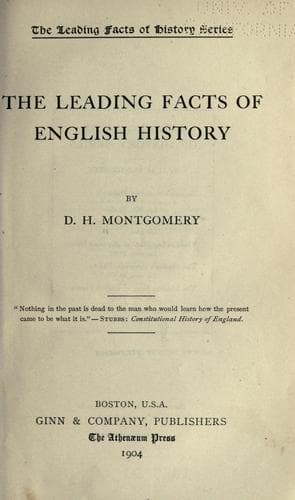
The Leading Facts of English HistoryMontgomery, D. H. (David Henry)
History
The Leading Facts of English History
Montgomery, D. H. (David Henry)
Great Britain -- History
The policy of the nation, on the other hand, was divided. The Whigs
were determined to limit the power of the Crown, and secure at all
hazards a Protestant successor to the throne. The Tories were equally
resolved to check the growing power of the people, and preserve the
hereditary order of succession (then in the Stuart family) without any
immediate regard to the religious question involved in the Exclusion
Bill (S478).
Beneath these issues both parties had a common object, which was to
maintain the National Episcopal Church and the monarchical system of
government. Whigs and Tories alike detested the principles of the
late Commonwealth period. They preferred to cherish patriotism
through loyalty to a personal sovereign rather than patriotism through
devotion to a democratic republic.
James II--1685-1689
485. James II; his Proclamation; his Two Objects; Titus Oates again.
James, Duke of York, brother of the late Charles II, now came to the
throne. He at once issued a Proclamation pledging himself to
"preserve the government in both Church and State as it is now by law
established." This solemn declaration was welcomed as "the word of a
king," but unfortunately that king did not keep his word. His first
great ambition was to rule independently of Parliament, so that he
might have his own way in everything; his second, which was, if
possible, still nearer his heart, was to restore the Roman Catholic
religion in England (SS370, 382, 477).
He began that restoration at once; and on the Easter Sunday preceding
his coronation, "the worship of the Church of Rome was once more,
after an interval of a hundred and twenty-seven years, performed at
Westminster with royal splendor."[1]
[1] Macaulay's "England."
Not long afterwards James brought the miscreant Oates to trial for the
perjuries he had committed in connection with the so-called "Popish
Plot" (S478). He was found guilty and sentenced to imprisonment for
life; in addition he was publicly whipped through London with such
terrible severity that a few more strokes of the lash would have ended
his worthless life (1685). But in the next reign Oates was liberated
and a pension was granted him.
486. Monmouth's Rebellion; Sedgemoor, 1685.
Public-domain text, read in full here on John Shaqi.
Reviews
Reviews
No reviews yet
Be the first to share your thoughts on this work.
Elsewhere in the archive
Join the Discussion
Join the discussion
Sign in to leave a comment or review.
Sign InorCreate an account