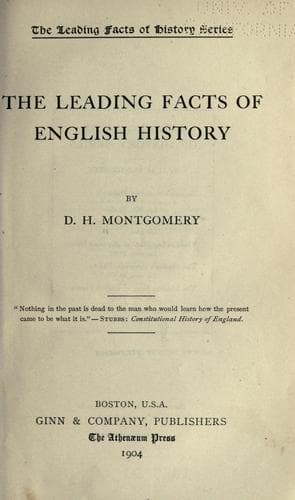
The Leading Facts of English HistoryMontgomery, D. H. (David Henry)
History
The Leading Facts of English History
Montgomery, D. H. (David Henry)
Great Britain -- History
Thereupon the Scotch authorities sent a body of soldiers to Glencoe,
who were hospitably received by the Macdonalds. After stopping with
them a number of days, they rose before light one winter morning, and,
suddenly attacking their friendly hosts, murdered all the men who did
not escape, and drove the women and children into the snowdrifts to
perish of cold and hunger.
They finished their work of destruction by burning the cabins and
driving away the cattle. By this act, Glencoe, or the "Glen of
Weeping," was changed into the Valley of the Shadow of Death. The
blame which attaches to William is that he did nothing toward
punishing those who planned and carried out the horrible massacre.
502. La Hogue; the Peace of Ryswick, 1697.
The English naval commander, Admiral Russell, like many of William's
pretended friends and supporters, had been engaged in treasonable
correspondence with James II. If the latter succeeded in recovering
his crown, the Admiral hoped to bask in the sunshine of royal favor;
but he later changed his mind and fought so bravely in the sea fight
off La Hogue that the French supporters of James were utterly beaten.
King William, however, continued his Continental wars for the next
five years, until, by the Peace of Ryswick, in Holland, 1697, Louis
XIV bound himself to recognize William as King of England, the
Princess Anne[1] as his successor, to withdraw all support from James,
and to place the chief fortresses of the Netherlands, or Low
Countries, in the hands of the Dutch garrisons. The Peace of Ryswick
marked the end of the conspiracy between Louis and the Stuarts to turn
England into a Roman Catholic country dependent on France (SS477,
488). When William went in solemn state to return thanks for the
conclusion of the war, it was to the new cathedral of St. Paul's,
which Wren had nearly completed (S474), and which was then first used
for public worship.
[1] The second (Protestant) daughter of James II. See Genealogical
Table, p. 323.
503. The National Debt, 1693; the Bank of England, 1694.
William had now gained, at least temporarily, the object that he had
in view when he accepted the English crown. He had succeeded in
drawing the English into a close defensive alliance against Lois
XIV,[2] who, as we have seen, was bent on destroying both the
political and the religious liberty of the Dutch as a Protestant
people (S476).
[2] Guizot's "History of Civilization," chap. xiii.
William's wars had compelled him to borrow large sums from the London
merchants. Out of these loans sprang the permanent National Debt.
That debt was destined to grow from less than a million of pounds to
so many hundred millions that all thought of ever paying it has long
since been given up. Furthermore, it became necessary to organize a
Banking Company, 1694, for the management of this collosal debt;
together the two were destined to become more widely known than any of
William's victories.
Public-domain text, read in full here on John Shaqi.
Reviews
Reviews
No reviews yet
Be the first to share your thoughts on this work.
Elsewhere in the archive
Join the Discussion
Join the discussion
Sign in to leave a comment or review.
Sign InorCreate an account