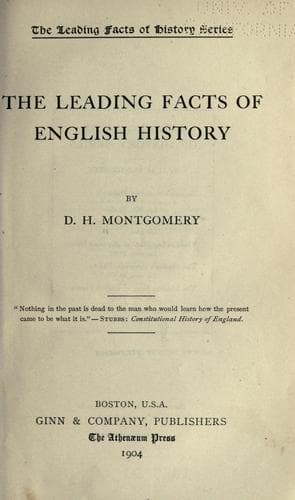
The Leading Facts of English HistoryMontgomery, D. H. (David Henry)
History
The Leading Facts of English History
Montgomery, D. H. (David Henry)
Great Britain -- History
Parliament now, 1689, passed the Bill of Rights, the third great
charter for the protection of the English people, and later confirmed
it, 1701, by the Act of Settlement, which secured the crown to a line
of Protestant sovereigns. The Mutiny Bill, passed at the beginning of
William III's reign, made the army dependent on Parliament. These
measures practically put the government in the hands of the House of
Commons, where it has ever since remained. The Long Parliament had
passed a Triennial Act (1641) requiring a new Parliament to be
summoned within three years from the dissolution of the last
Parliament, which was to sit not longer than three years. This law
was repealed in 1664 and reenacted under William III in 1694.
William's wars caused the beginning of the National Debt and the
establishment of the Bank of England.
In the reign of Anne, 1707, Scotland and England were united under the
name of Great Britain. During her sovereignty the permanent Whig and
Tory parties, which came into existence in the time of Charles II,
became especially prominent. They have since continued to divide the
parliamentary government between them,--the Whigs seeking to extend
the power of the people; the Tories, that of the Crown and the
Church. After the passage of the Reform Bill in 1832 (S582) the Whigs
took the name of Liberals and the Tories that of Conservatives. The
system of Cabinet Government, which now prevails, took its rise in
1721 under Robert Walpole, seven years after Anne's death (S534).
II. Religion
518. Religious Parties and Religious Legislation.
At the beginning of this period we find four religious parties in
England: (1) the Roman Catholics; (2) the Episcopalians, or supporters
of the National Church of England; (3) the Puritans, who wised to
remain members of that Church, but who sought to "purify" it from
certain Roman Catholic customs and modes of worship; (4) the
Independents, who were endeavoring to establish independent
congregational societies. In Scotland the Puritans established their
religion in a Church governed by elders, or presbyters, instead of
bishops, which on that account got the name of Presbyterians.
James I persecuted all who dissented from the Church of England; and
after the Gunpowder Plot the Roman Catholics were practically deprived
of the protection of the law, and subject to terrible oppression. In
James's reign Bartholomew Legate, a Unitarian, was burned at West
Smithfield Market, London (1612), for denying the doctrine of the
trinity. He was the last English martyr. Charles I greatly
exasperated the Puritans in the English Church by his Declaration of
Sports, which recommended games in the churchyards after service on
Sunday. Clergymen who refused to read the Declaration to their
congregation were dismissed from their places.
Public-domain text, read in full here on John Shaqi.
Reviews
Reviews
No reviews yet
Be the first to share your thoughts on this work.
Elsewhere in the archive
Join the Discussion
Join the discussion
Sign in to leave a comment or review.
Sign InorCreate an account