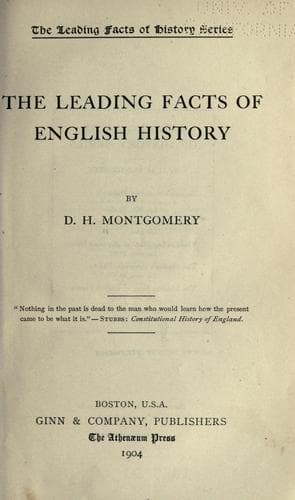
The Leading Facts of English HistoryMontgomery, D. H. (David Henry)
History
The Leading Facts of English History
Montgomery, D. H. (David Henry)
Great Britain -- History
Sir Isaac Newton revolutionized natural philosophy by his discovery
and demonstration of the law of gravitation, and Dr. William Harvey
accomplished as great a change in physiological science by his
discovery of the circulation of the blood. The most remarkable
invention of the age was a rude steam engine, patented in 1698 by
Captain Savery, and so far improved by Thomas Newcomen in 1712 that it
was used for pumping water in coal mines for many years. Both were
destined to be superseded by James Watt's engine, which belongs to a
later period (1765).
522. Architecture.
The Gothic style of the preceding periods was followed by the Italian,
or classical, represented in the works of Inigo Jones and
Sir Christopher Wren. It was a revival, in modified form, of the
ancient Greek and Roman architecture. St. Paul's Cathedral, the
grandest church ever built in England for Protestant worship, is the
best example of this style. Many beautiful manor houses were built in
the early part of this period, which, like the churches of the time,
were often ornamented with the exquisite wood carving of Grinling
Gibbons. There were no great artists in England in this age, though
Charles I employed Rubens and other foreign painters to decorate the
palace of Whitehall and Windsor Castle.
523. Education.
The higher education of the period was confined almost wholly to the
study of Latin and Greek. The discipline of all schools was extremely
harsh. Nearly every lesson was emphasized by a liberal application of
the rod, and the highest recommendation a teacher could have was that
he was known as "a learned and lashing master."
V. General Industry and Commerce
524. Manufactures.
Woolen goods continued to be a chief article of manufacture. Silks
were also produced by thousands of Huguenot weavers, who fled from
France to England in order to escape the persecutions of Louis XIV.
Coal was now extensively mined, and iron and pottery works were giving
industrial importance to Birmingham and other growing towns in the
Midlands.
525. Commerce.
A permanent English colony was established in America in 1607, and by
1714 the number of such colonies had increased to twelve. During a
great part of this period intense commercial rivalry existed between
England and Holland, each of which was anxious to get the monopoly of
the colonial import and export trade. Parliament passed stringent
navigation laws, under Cromwell and later, to prevent the Dutch from
competing with English merchants and shippers. The East India and
South Sea companies were means of greatly extending English commercial
enterprise, as was also the tobacco culture of Virginia.
526. Roads and Travel.
Public-domain text, read in full here on John Shaqi.
Reviews
Reviews
No reviews yet
Be the first to share your thoughts on this work.
Elsewhere in the archive
Join the Discussion
Join the discussion
Sign in to leave a comment or review.
Sign InorCreate an account