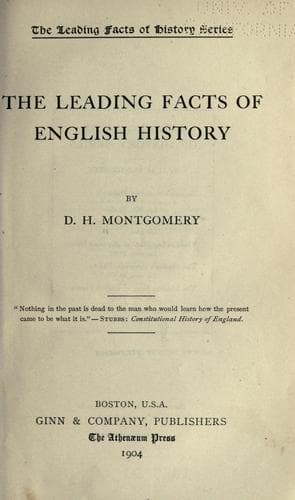
The Leading Facts of English HistoryMontgomery, D. H. (David Henry)
History
The Leading Facts of English History
Montgomery, D. H. (David Henry)
Great Britain -- History
But among the new things which the people were to try in that century
was one which led to most beneficient results. For many generations
the great scourge of Europe was the smallpox. Often the disease was
as violent as the plague (S474), and carried off nearly as many
victims. Medical art, seemed powerless to deal with it, and even in
years of ordinary health in England about one person out of ten died
of this loathsome pestilence. In the early part of George I's reign,
Lady Mary Montagu, then traveling to Turkey, wrote that the Turks were
in the habit of inoculating their children for the disease, which
rendered it much milder and less fatal, and that she was about to try
the experiment on her own son.
Later, Lady Montagu returned to England, and through her influence and
example the practice was introduced there, 1721. It was tried first
on five criminals in Newgate who had been sentenced to the gallows,
but were promised their freedom if they would consent to the
operation. As it proved a complete success, the Princess of Wales,
with the King's consent, caused it to be tried on her daughter, with
equally good results.
The medical profession, however, generally refused to sanction the
practice, and the clergy in many cases preached against it as an
"invention of Satan, intended to counteract the purposes of an
all-wise Providence." But through the perseverance and good sense of
Lady Montagu, with a few others, the new practice gradually gained
ground. Subsequently Dr. Jenner began to make experiments of a
different kind, which led, late in the century (1796-1798), to the
discovery of vaccination, by which millions of lives have been saved;
this, and the discovery of the use of ether in our own time (S615),
may justly be called two of the greatest triumphs of the art of
medicine.
538. How Sir Robert Walpole governed.
We have seen that Sir Robert Walpole (S534) became the first Prime
Minister in 1721, and that he continued in office as head of the
Cabinet, or Government, until near the middle of the next reign. He
was an able financier, and succeeded in reducing the National Debt
(S503). He believed in keeping the country out of war, and also, as
we have seen, out of "bubble speculation" (S536). Finally, he was
determined at all cost to maintain the Whig party in power, and the
Protestant Hanoverian sovereigns on the throne (SS515, 532).
Public-domain text, read in full here on John Shaqi.
Reviews
Reviews
No reviews yet
Be the first to share your thoughts on this work.
Elsewhere in the archive
Join the Discussion
Join the discussion
Sign in to leave a comment or review.
Sign InorCreate an account