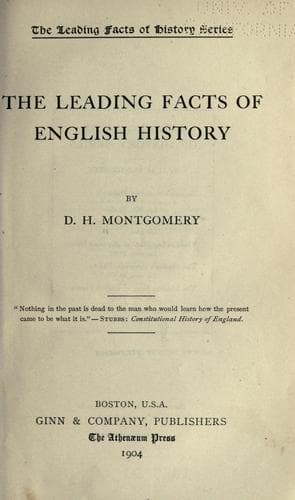
The Leading Facts of English HistoryMontgomery, D. H. (David Henry)
History
The Leading Facts of English History
Montgomery, D. H. (David Henry)
Great Britain -- History
Before the contest had closed by which England won her Asiatic
dominions, a new war had broken out. In the fifth year, 1756, of the
New Style[2] of reckoning time, the aggressive designs of Frederick
the Great of Prussia caused such alarm that a grand alliance was
formed by France, Russia, Austria, and Poland to check his further
advance. Great Britain, however, gave her support to Frederick, in
hope of humbling her old enemy France, who, in addition to her
attempts to oust the English from India, was also making preparations
on a grand scale to get possession of America.
[2] The New Style was introduced into Great Britain in 1752. Owing to
a slight error in the calendar, the year had, in the course of
centuries, been gradually losing, so that in 1752 it was eleven days
short of what the true computation would make it. Pope Gregory
corrected the error in 1582, and his calendar was adopted in nearly
every country of Europe except Great Britain and Russia, both of which
regarded the change as a "popish measure." But in 1751,
notwithstanding the popular outcry, September 3, 1752, was made
September 14, by an act of Parliament, and by the same act the
beginning of the legal year was altered from March 25 to January 1.
The popular clamor against the reform is illustrated in Hogarth's
picture of an Election Feast, in which the People's party carry a
banner, with the inscription, "Give us back our eleven days."
Every victory, therefore, which the British forces could gain in
Europe would, by crippling the French, make the ultimate victory of
the English in America so much the more certain; for this reason we
may look upon the alliance with Frederick as an indirect means
employed by England to protect her colonies on the other side of the
Atlantic. These colonies now extended along the entire coast, from
the Kennebec Riber, in Maine, to the borders of Florida.
The French, on the other hand, had planted colonies at Quebec and
Montreal, on the St. Lawrence; at Detroit, on the Great Lakes; at New
Orleans and other points on the Mississippi. They had also begun to
build a line of forts along the Ohio River, which, when completed,
would connect their northern and southern colonies, and thus secure to
them the whole country west of the Alleghenies. They expected to
conquer the East as well, to erase Virginia, New England, and all
other English colonial titles from the map, and in their place to put
the name New France.
Public-domain text, read in full here on John Shaqi.
Reviews
Reviews
No reviews yet
Be the first to share your thoughts on this work.
Elsewhere in the archive
Join the Discussion
Join the discussion
Sign in to leave a comment or review.
Sign InorCreate an account